



CHIPNATION 2024: IMSE explores opportunities and challenges of neuromorphic technology
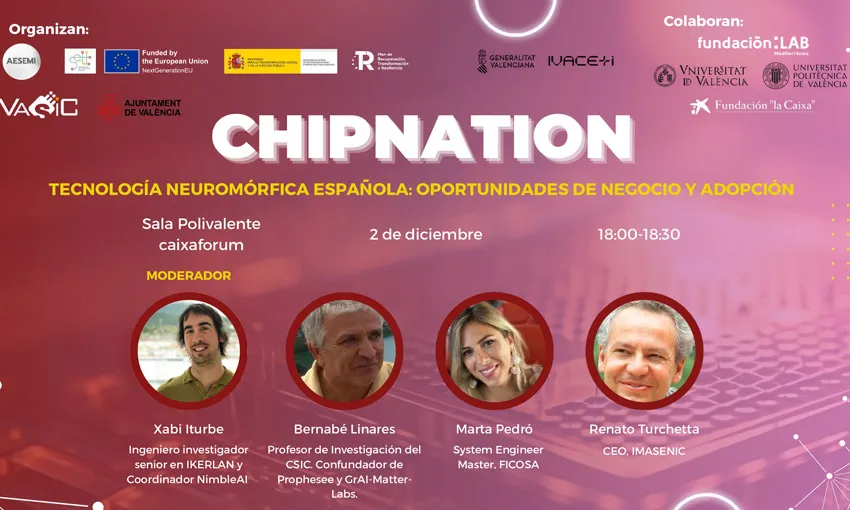
IMSE Full Professor of Research Bernabé Linares-Barranco participated as panelist in CHIPNATION 2024, the congress on microelectronics organized by "Asociación Española de la Industria de Semiconductores" – AESEMI, on 2-3 of December 2024 in Valencia.
2 min read
Prof. Bernabé Linares-Barranco, CSIC full professor of research at the “Instituto de Microelectrónica de Sevilla” (IMSE-CNM-CSIC-US), participated in the Experts Panel on “Tecnología Neurmórfica Española: Oportunidades de Negocio y Adopción” (Neuromorphic Technology in Spain: business opportunities and adoption), as an expert microchip designer and researcher on neuromorphic systems for about 38 years and co-founder of two neuromorphic companies: Prophesee, focused on neuromorphic vision sensors, and GrAI-Matter-Labs, focused on neuromorphic processors, recently acquired by SNAP Inc.
The panel was organized and moderated by Xabier Iturbe, research engineer at IKERLAN and leader of the AESEMI Neuromorphic Work-group. In the panel also participated Renato Turchetta, CEO of IMASENIC, a fabless chip design company focused on imagers, and Marta Pedró, System Engineer at FICOSA, an automotive sector provider company.
The panel emphasized the need of present day more energy-efficient solutions for AI (Artificial Intelligence) exploiting brain-inspired signal-encoding and processing techniques as well as nano-scale-based technologies. Present day AI is bringing an unsustainable exponential explosion in Energy consumption, where the main AI providers world-wide will consume over 30% of the planet electricity in the coming decades, and are already considering building their own fleet of nuclear plants just to feed AI. The panel discussed about the high interdisciplinary nature of neuromorphic engineering, ranging from biological neuroscience, computational neuroscience, algorithmic neuromorphic learning, electronics and chip design for neuromorphic sensors and processors, new materials and nanotechnology devices enabling high miniaturization, massive integration and relevant power savings, and the projection to industry and commercial exploitation, with new business opportunities, but also facing the present challenges of a still not fully mature set of technologies that has a hard time competing with well-established counterparts.
As the most advantageous neuromorphic technology, the experts agreed, the Dynamic Vision Sensor (DVS) is already commercially available with niche market opportunities. The experts also agreed that providing presently a full stack of neuromorphic technologies (from sensors and processors, to information encoding, processing, and learning solutions, for generic applications) is overwhelmingly challenging and non-practical. The future will probably see a smooth transition from present-day well-established technologies, progressively incorporation partial neuromorphic solutions for specific stages. This will require a sustainable, continuous, and progressive compatibility between conventional and new technologies with back-and-forth mapping of information representation, exploiting the optimum of both worlds as time, knowledge, and technologies progress.
Keep reading
Research
The IMSE-CNM will return to Brussels to bring cybersecurity closer to the European public
'Science is Wonderful!', the international science fair organized by the European Commission, will be held in Brussels from March 16 to 19, 2027, and will once again feature—for the fourth consecutive year—a team of researchers from the Institute of Microelectronics of Seville (IMSE-CNM)
Research
IMSE is co-leading a European project that seeks to strengthen technological autonomy in semiconductors
The ODE4EC-AMS initiative, which brings together 25 partners from 11 countries and has a budget exceeding €15 million, seeks to boost European competitiveness and technological autonomy and facilitate access to advanced chip design technologies
Research
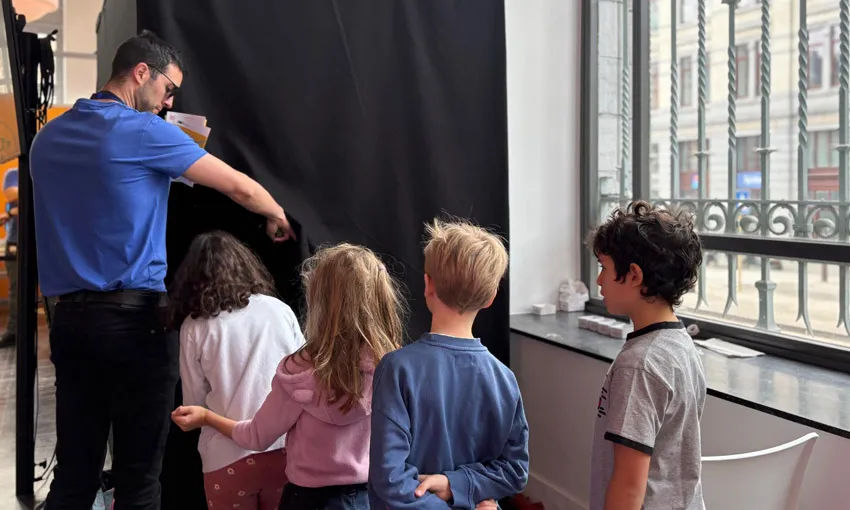
Dodging lasers to understand digital security
Through a laser maze and cryptographic challenges, researchers from the center brought key concepts of digital protection closer to hundreds of students from all over Europe