


Skip to content

On offer 12

Patents in force, available for licensing.

On offerPriority

Method and device for monitoring the output signal of nano-oscillators

This invention introduces a compact device and a simplified method for monitoring nano-oscillators while enhancing performance. By capturing the output of nano-oscillators directly on-chip, both size and energy consumption are significantly reduced, eliminating the need for external radio frequency detectors.

It is also scalable and versatile, making it adaptable for neuromorphic computing applications or small-scale magnetic sensors.

Status
Patent pending
Inventors
Fiorelli Martegani, Rafaella Bianca; Peralías Macías, Eduardo
Holder
Spanish National Research Council and University of Seville
Group
Intelligent, Reliable and Secure MicroelectronicsASICs for Harsh Environments

Leaflet · PDF
On offerPriority

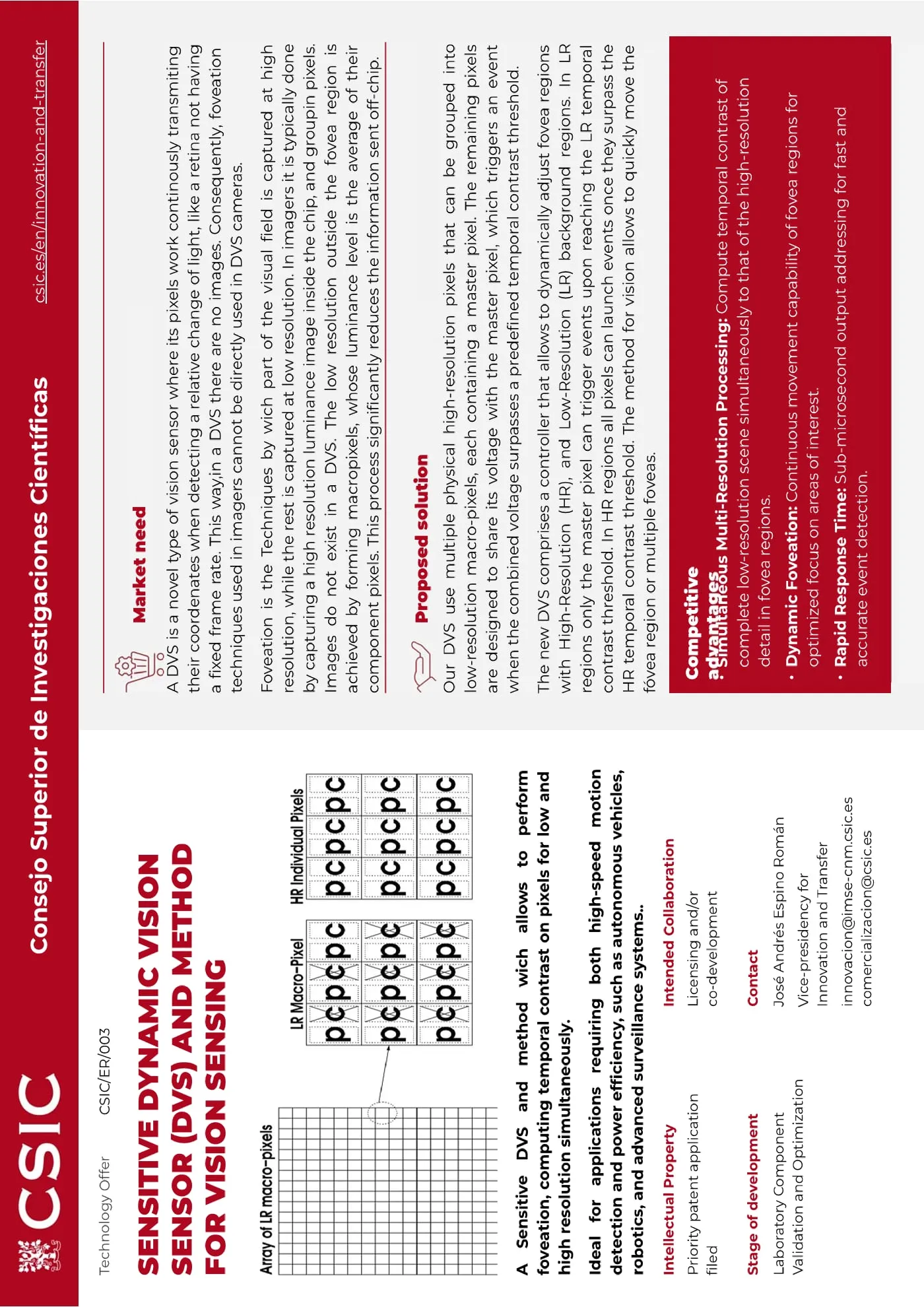
Sensitive Dynamic Vision Sensor (sDVS) and Method for vision sensing

A sensitive DVS and method wich allows to perform foveation, computing temporal contrast on pixels for low and high resolution simultaneously.

Ideal for applications requiring both high-speed motion detection and power efficiency, such as autonomous vehicles, robotics and advanced surveillance systems.

Status
Patent pending
Inventors
Linares Barranco, Bernabé; Serrano Gotarredona, Teresa
Holder
Spanish National Research Council
Leaflet · PDF

On offerPriority

Acousto-Optic System & Method for generating PUFs

This method to generate strong physical unclonable functions (PUFs) uses acousto-optic systems. In this system the acousto-optic medium modulates an optical beam to generate multiple patterns used to probe a PUF based in optical scattering. This system allows to reduce complexity while maintaining high integrability and reliability.

Multiple challenge-response pairs can be generated by varying the properties of the acoustic signal or by using multiple acousto-optic mediums could arranged sequentially. In addition, this acousto-optic system can be implemented as a photonic integrated circuit (PIC), enabling its miniaturisation and integration in Internet-of-Things (IoT) devices.

Status
Patent pending
Inventors
Martín Sánchez, David; Brox Jiménez, Piedad
Holder
Spanish National Research Council
Leaflet · PDF

On offerPriority

Method and Hardware for single-shot simultaneous AE and HDR imaging

This sensing method for simultaneous realization of auto-exposure (AE) and high dynamic range (HDR) during image capture. Hardware implementation based on pixel array circuitry that automatically adjusts its response to the ambient illumination and fits the radiance map of the scene into the available signal range. Linear sensor response for low levels

of light intensity and non-linear sensing response for high levels of light intensity – “low” and “high” relative to the ambient illumination. No extra time apart from the photo-integration interval needed to generate a HDR image. Arbitrary radiance maps can be accommodated into the available signal range. Asynchronous operation of the proposed circuitry once the pixels are reset, requiring no external control.

Industrial partners are sought to collaborate through a patent licence agreement.

Status
Patent pending
Inventors
Carmona Galán, Ricardo; Fernández Berni, Jorge; Lamouraa Sedlackova, Yassine
Holder
Spanish National Research Council and University of Seville
Leaflet · PDF
On offerPriority

Semiconductor Particle Detector Device

This radiation-resistant semiconductor device is integrated into standard CMOS manufacturing technology. It acts as an active pixel in imaging detectors. It is capable of capturing images by detecting charged particles with energies in the range of 1 to 10 KeV. Its operation is based on measuring the electrostatic charge generated in a capacitor when it is irradiated by radiation. It uses MiM capacitors available in standard CMOS processes. The device can detect and measure both the sign and variations of the charge induced on a floating metal electrode. The pixel distribution allows the spatial distribution of the ionizing radiation flux to be measured.

Industrial partners are sought to collaborate through a patent licence agreement.

Status
Patent pending
Inventors
Carmona Galán, Ricardo; Leñero Bardallo, Juan Antonio; Johanny Sáenz Noval, Jorge; Cervera Gontard, Lionel
Holder
Spanish National Research Council, University of Seville and University of Cadiz
Leaflet · PDF

On offerPriority

Pixel for DVS vision sensors with one or more photodiodes operating in photovoltaic regime

Csic and the University of Seville have developed a new Pixel arquitecture for DVS vision sensors with one or more photodiodes operating in photovoltaic regime. In this Pixel arquitecture, type "Dinamic Vision Sensor", its generated outputs pulses when the pixel detects temporary lighting variations. Its utilice several photodiodes, operating in photovoltaic region, like photoreceptors. The anode of this photodiodes can be directly connected to a buffer or voltage follower, whithout the necesity of using a logarithmic photoreceptor, reducing the dimensions of pixel respect other existing arquitectures.

Status
Patent pending
Inventors
Leñero Bardallo, Juan Antonio; Rodríguez Vázquez, Ángel; Fernández Peramo, Pablo
Holder
University of Seville and Spanish National Research Council

On offerPriority

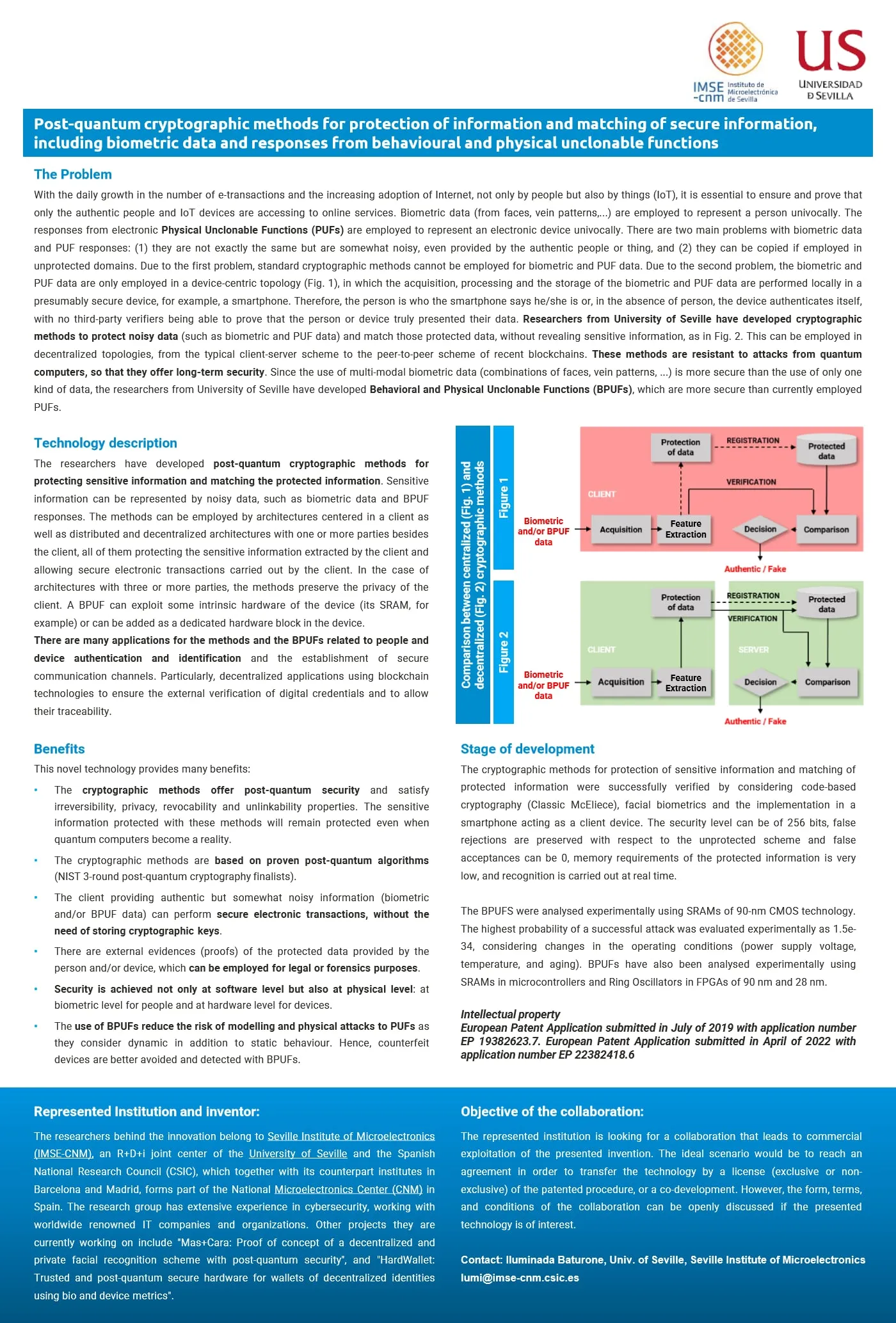
Computer-implemented methods for post-quantum protection of information and for post-quantum secure information matching and cryptographic systems to perform the computer-implemented methods

The present invention relates to post-quantum cryptographic methods for protecting sensitive information and matching the protected information. Sensitive information 10 can be represented by noisy data, in the sense that the data associated with identical sensitive information can show some differences among them when they are measured at different times. An example of noisy data is the data obtained from measurements of persons' and things' traits that are univocally associated with their physical entities, such as persons' biometric data.

Status
Patent pending
Inventors
Baturone Castillo, Mª Iluminada; Arjona López, María Rosario; López González, Paula; Román Hajderek, Roberto
Holder
University of Seville and Spanish National Research Council
Group
Hardware for Cybersecurity
Leaflet · PDF

On offerPriority

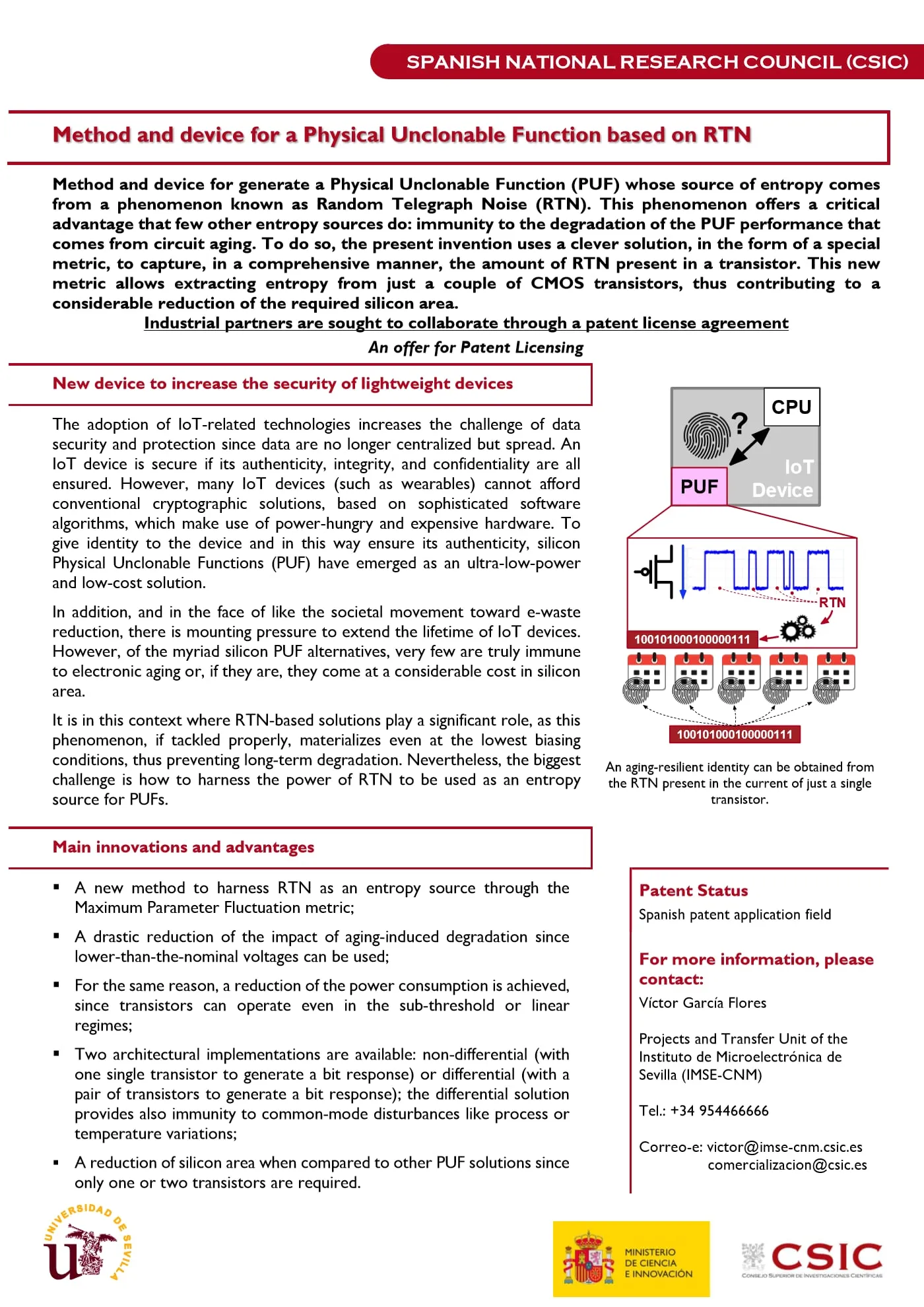
Method and device for PUF based on RTN

CSIC and the University of Seville have developed a method and device for a Physical Unclonable Function (PUF) whose source of entropy comes from the phenomenon known as Random Telegraph Noise (RTN). The key element that differentiates the present invention from similar inventions that might use this phenomenon is the fact that it uses a metric that can capture, in a comprehensive manner, the amount of RTN present in each transistor. This invention allow that a PUF response can be obtained and can be used, for example, to authenticate any hardware element to which an instance of the PUF device is bound.

Status
Patent pending
Inventors
Roca Moreno, Elisenda; Castro López, Rafael; Brox Jiménez, Piedad; Camacho Ruiz, Eros; Fernández Fernández, Francisco Vidal
Holder
University of Seville and Spanish National Research Council
Leaflet · PDF

On offerPriority

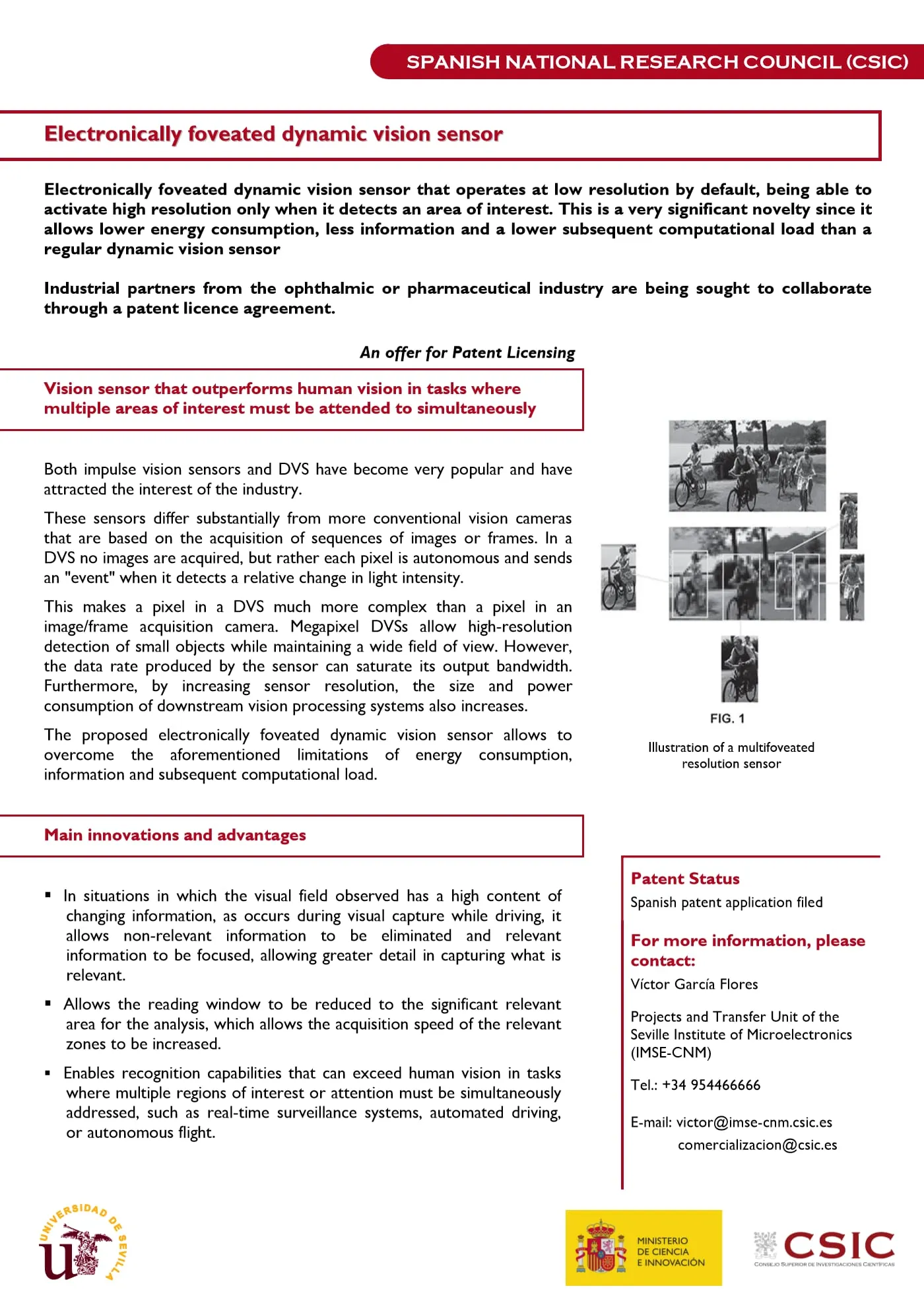
Electronically foveated dynamic vision sensor

CSIC and the University of Seville have developed an electronically foveated dynamic vision sensor that operates at a low resolution by default, being able to activate high resolution only when it detects an area of interest. This is a very significant novelty since it allows lower energy consumption, less information and a lower subsequent computational load than a regular dynamic vision sensor.

Status
Patent pending
Inventors
Linares Barranco, Bernabé; Serrano Gotarredona, Teresa
Holder
Spanish National Research Council and University of Seville
Leaflet · PDF

On offerPriority

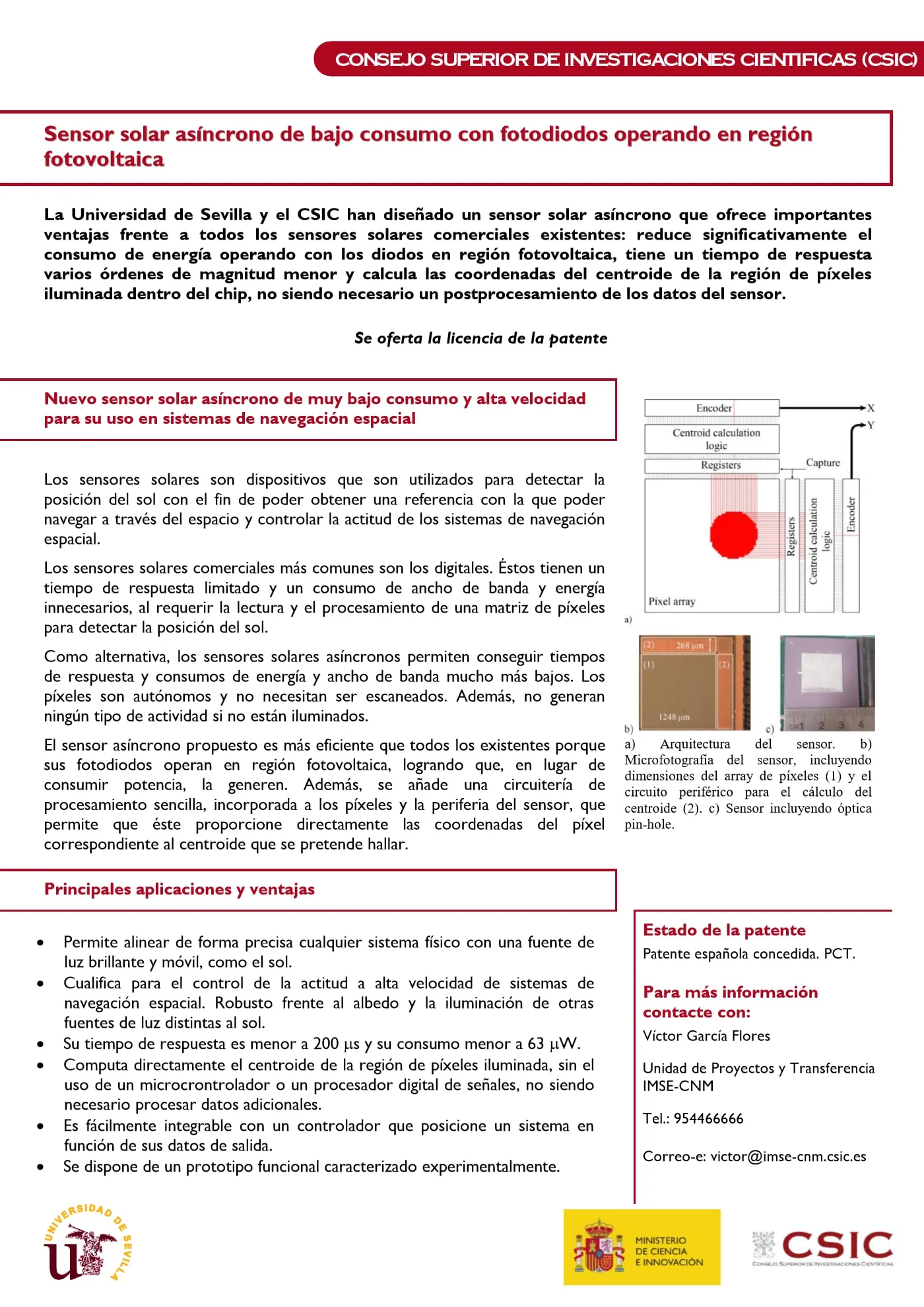
Low-Power asynchronous solar sensor

CSIC and the University of Seville have designed an asynchronous solar sensor with important advantages in front of all existing comercial solar sensors: it significantly reduces power consumption by operating the diodes in the photovoltaic region, it has a response time several orders of magnitude faster, and it calculates the coordenates of the centroid of the pixel region inside the chip, requiring no post-processing of the sensor data.

Status
Spanish patent granted. PCT application filed
Inventors
Leñero Bardallo, Juan Antonio; Gómez Merchán, Ruben; Rodríguez Vázquez, Ángel
Holder
University of Seville and Spanish National Research Council
Leaflet · PDF
On offerPriority

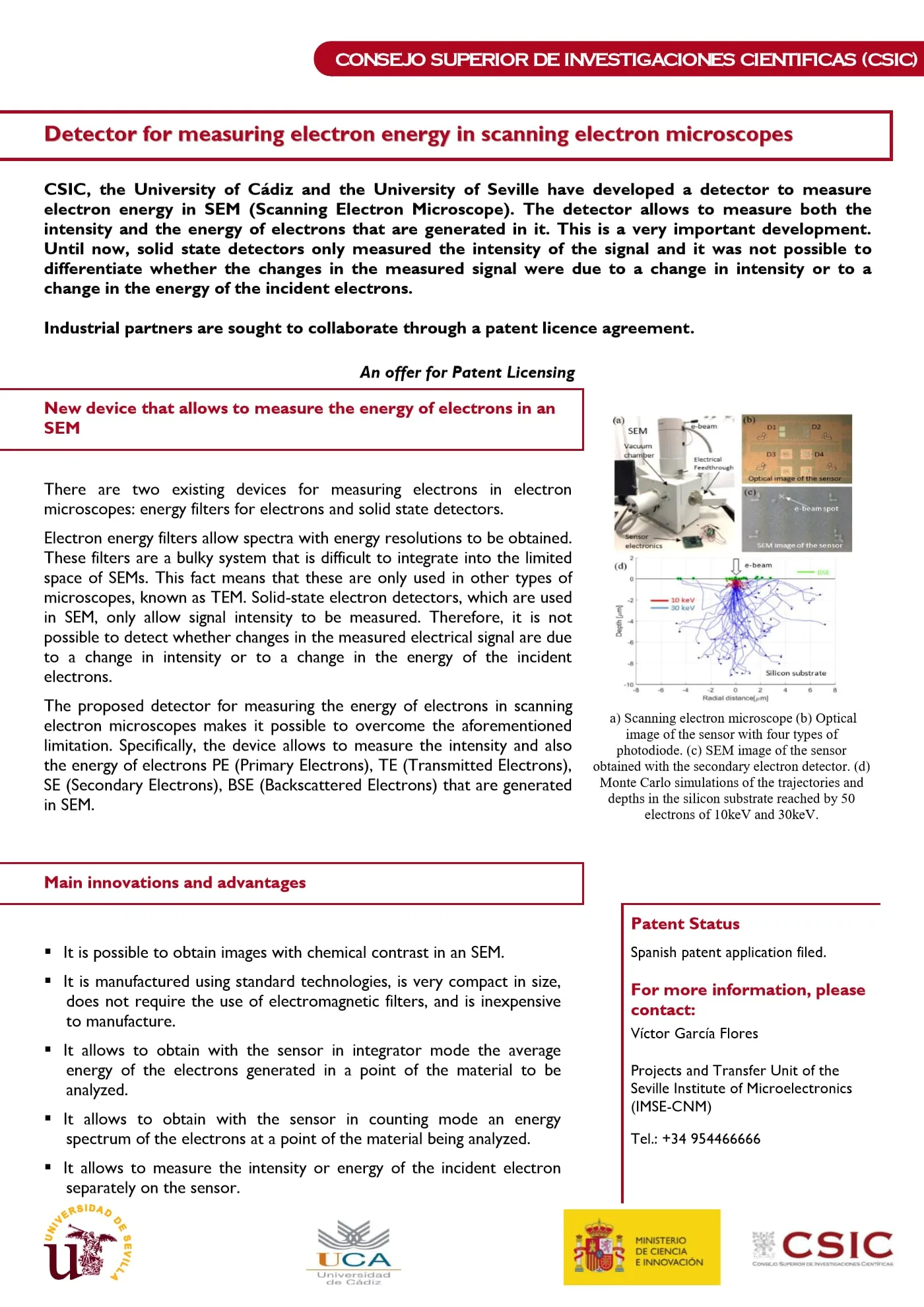
Detector for measuring electron energy in scanning electron microscopes

CSIC, the University of Cadiz and the University of Seville have developed a detector to measureelectron energy in SEM (Scaning Electron Microscope). The detector allows to measure both the intensity and the energy of electrons that are generated in it. This is a very important development. Until now, solid state detectors only measured the intensity of the signal and it was not possble to differentiate wether the changes in the measured signal were due to a change in intensity or to a change in the energy of the incident electrons.

Status
Spanish patent granted. PCT application filed
Inventors
Carmona Galan, Ricardo; Leñero Bardallo, Juan Antonio; Cervera Gontard, Lionel
Holder
University of Seville, University of Cadiz and Spanish National Research Council
Leaflet · PDF

On offerPriority

Direct sensor for electron microscopy with in-pixel energy measurement

CSIC has developed a pixelated direct sensor to capture high-resolution images using electron

microscopes. Each pixel of the sensor uses more than one electrode to measure the charge generated, and the output of the sensor comprises values of intensity​​ and energy of the electrons that impact the sensor. This enriched representation is very useful for taking images or spectra of materials with high dynamic range, and to extract chemical information. Industrial partners are sought to collaborate through a patent licence agreement.

Status
Patent pending
Inventors
Carmona Galan, Ricardo; Cervera Gontard, Lionel
Holder
Spanish National Research Council
Patent · PDF
Licensed 8

Patents already exploited by technology companies.

LicensedPriority

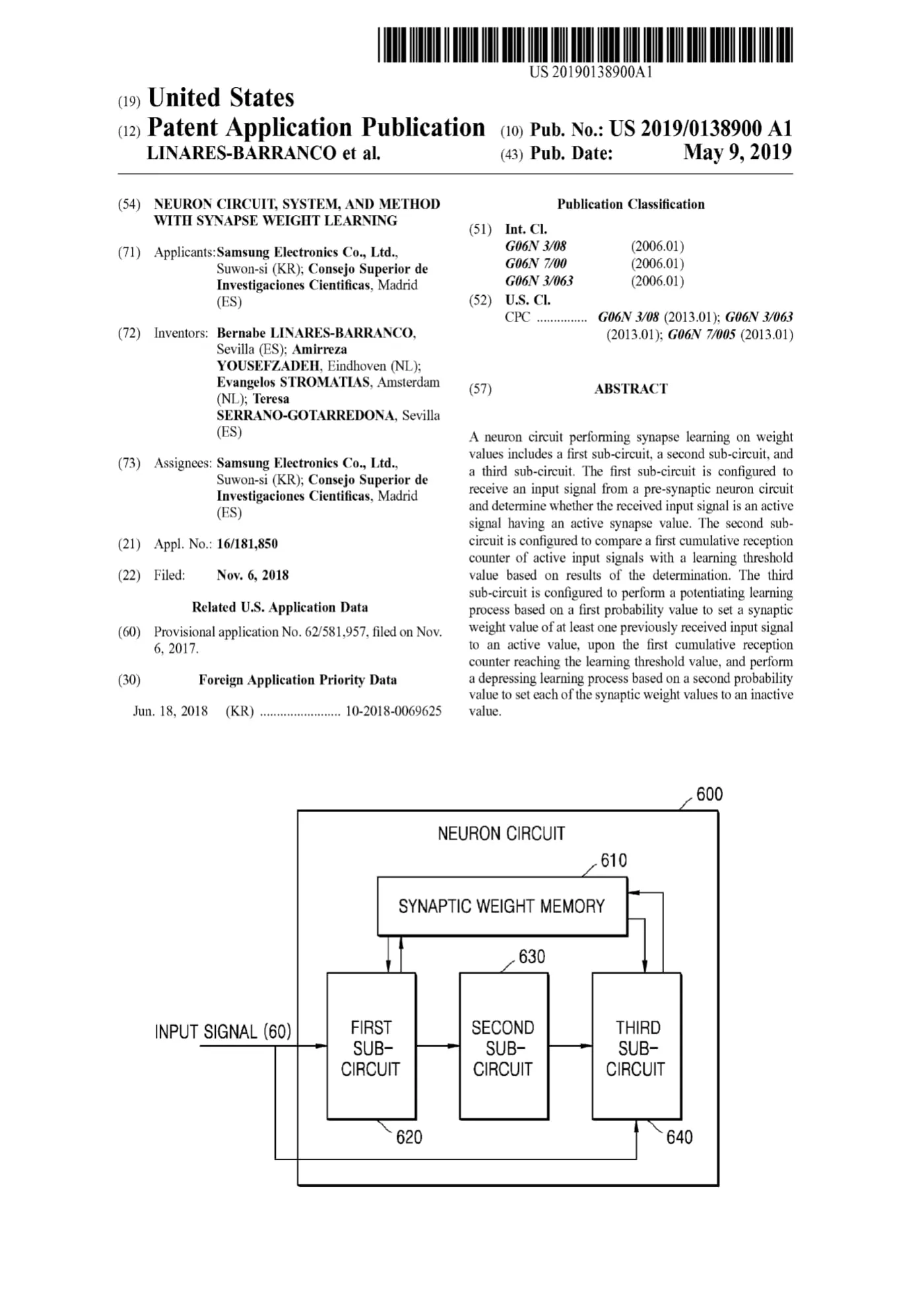
Neuron Circuit system and method for synapse weight learning

A neuron circuit performing synapse learning on weight values includes a first sub-circuit, a second sub-circuit, and a third sub-circuit. The first sub-circuit is configured to receive an input signal from a pre-synaptic neuron circuit and determine whether the received input signal is an active signal having an active synapse value. The second sub-circuit is configured to compare a first cumulative reception counter of active input signals with a learning threshold value based on results of the determination. The third sub-circuit is configured to perform a potentiating learning process based on a first probability value to set a synaptic weight value of at least one previously received input signal to an active value, upon the first cumulative reception counter reaching the learning threshold value, and perform a depressing learning process based on a second probability value to set each of the synaptic weight values to an inactive value.

Inventors
Stromatias, Evangelos; Yousefzadeh, Amirreza
Holder
Spanish National Research Council and Samsung Electronics CO
Patent · PDF
LicensedPriority

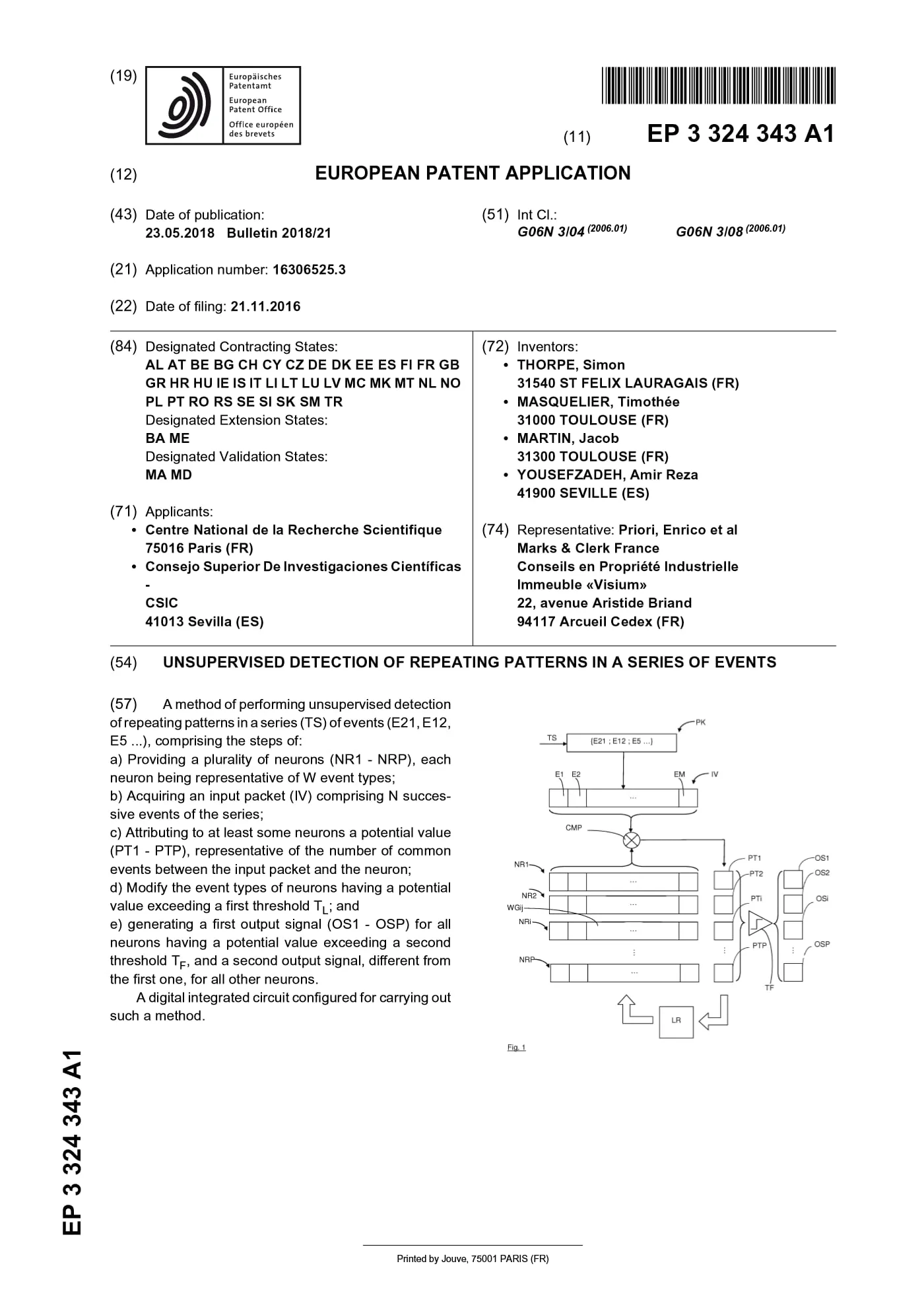
Unsupervised detection of repeating patterns in a series of events

A method of performing unsupervised detection of repeating patterns in a series (TS) of events (E21, E12, E5 ...), comprising the steps of:

a) Providing a plurality of neurons (NR1 - NRP), each neuron being representative of W event types

b) Acquiring an input packet (IV) comprising N successive events of the series

c) Attributing to at least some neurons a potential value (PT1 - PTP), representative of the number of common events between the input packet and the neuron

d) Modify the event types of neurons having a potential value exceeding a first threshold TL; and

e) generating a first output signal (OS1 - OSP) for all neurons having a potential value exceeding a second threshold TF, and a second output signal, different from the first one, for all other neurons.

A digital integrated circuit configured for carrying out such a method.

Inventors
Thorpe, Simon; Masquelier, Timothée; Martin, Jacob; Yousefzadeh, Amir Reza
Holder
Spanish National Research Council and Centre National de la Recherche Scientifique
Patent · PDF

LicensedPriority

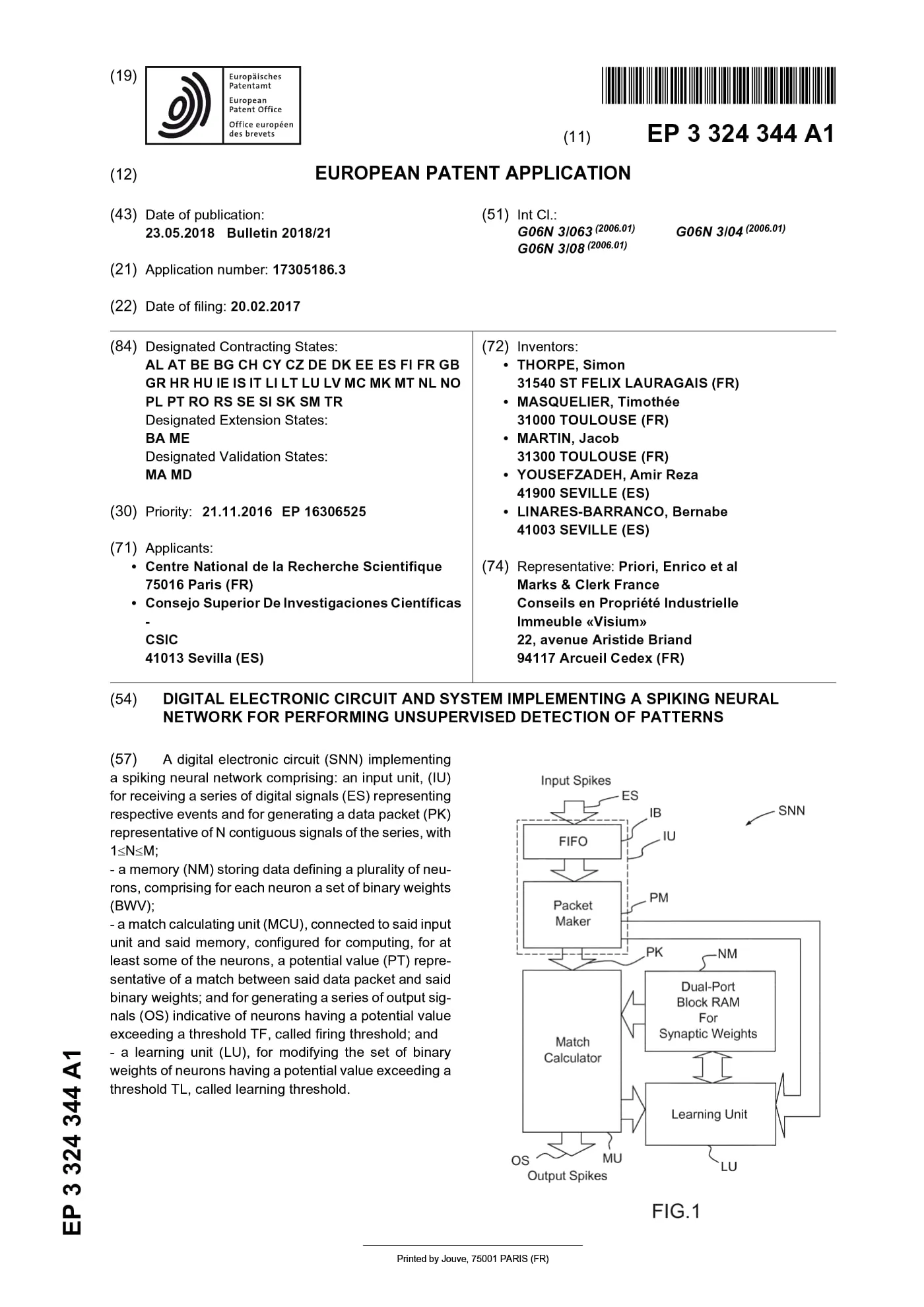
Digital electronic circuit and system implementing a spiking neural network for performing unsupervised detection of patterns

A digital electronic circuit (SNN) implementing a spiking neural network comprising: an input unit, (IU) for receiving a series of digital signals (ES) representing respective events and for generating a data packet (PK) representative of N contiguous signals of the series, with 1≤N≤M; a memory (NM) storing data defining a plurality of neurons, comprising for each neuron a set of binary weights (BWV); a match calculating unit (MCU), connected to said input unit and said memory, configured for computing, for at least some of the neurons, a potential value (PT) representative of a match between said data packet and said binary weights; and for generating a series of output signals (OS) indicative of neurons having a potential value exceeding a threshold TF, called firing threshold; and a learning unit (LU), for modifying the set of binary weights of neurons having a potential value exceeding a threshold TL, called learning threshold

Inventors
Thorpe, Simon; Masquelier, Timothée; Martin, Jacob; Yousefzadeh, Amir Reza
Holder
Centre National de la Recherche Scientifique and Spanish National Research Council
Patent · PDF

LicensedPriority

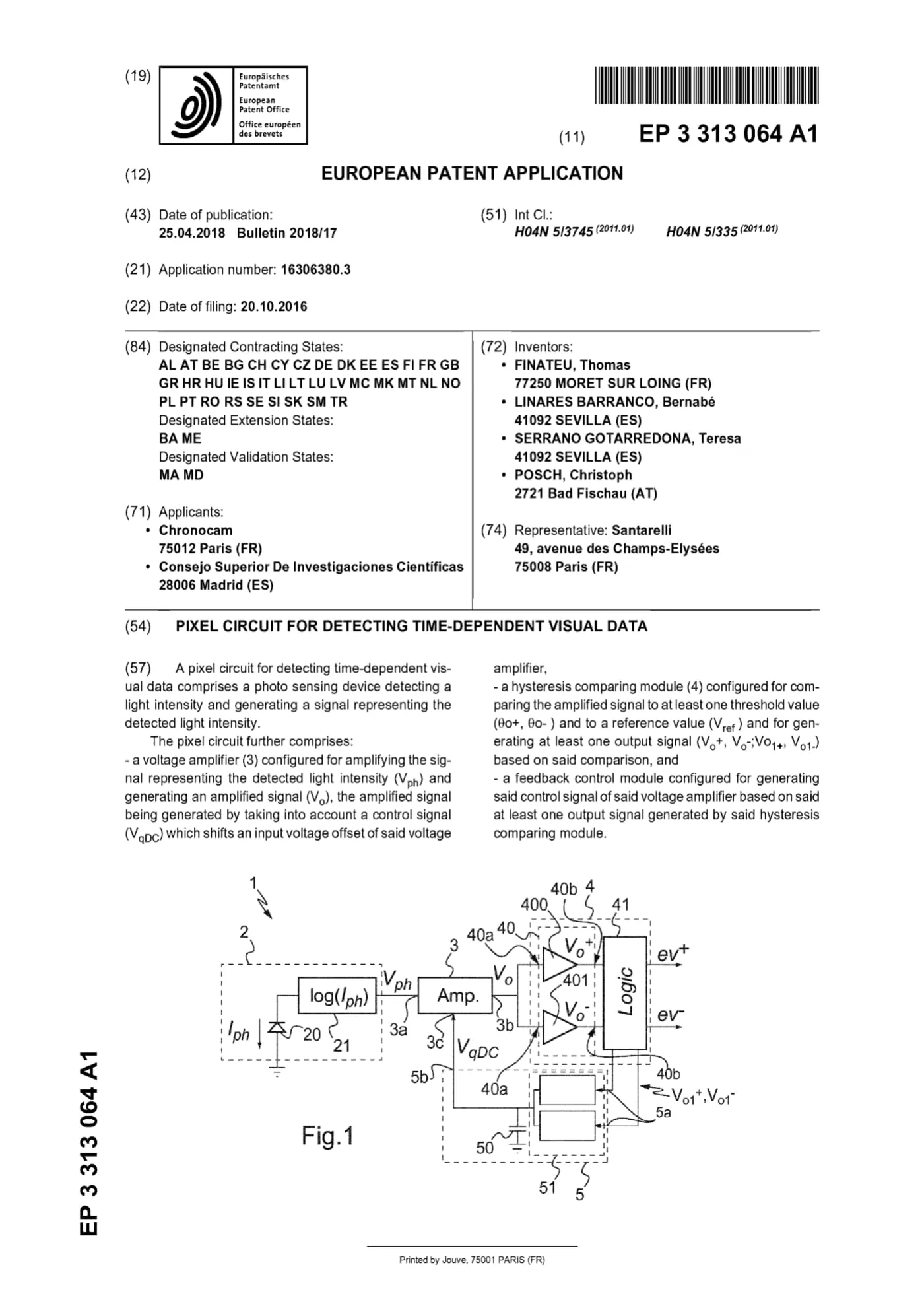
Pixel circuit for detecting time-dependent visual data

A pixel circuit for detecting time-dependent visual data comprises a photo sensing device detecting a light intensity and generating a signal representing the detected light intensity. The pixel circuit further comprises: - a voltage amplifier configured for amplifying the signal representing the detected light intensity (V ph ) and generating an amplified signal (V o ), the amplified signal being generated by taking into account a control signal (V qDC ) which shifts an input voltage offset of said voltage amplifier, - a hysteresis comparing module configured for comparing the amplified signal to at least one threshold value (¸o+, ¸o- ) and to a reference value (V ref ) and for generating at least one output signal (V o +, V o -;Vo 1+ , V o1- ) based on said comparison, and - a feedback control module configured for generating said control signal of said voltage amplifier based on said at least one output signal generated by said hysteresis comparing module.

Status Licensed Patent Priority Date 20/10/2016 Licensee: Prophesse

Licensed to
Prophesee
Inventors
Finateu, Thomas; Linares-Barranco, Bernabé; Serrano-Gotarredona, Teresa; Posch, Christoph
Holder
Chronocam and Spanish National Research Council
Patent · PDF

LicensedPriority

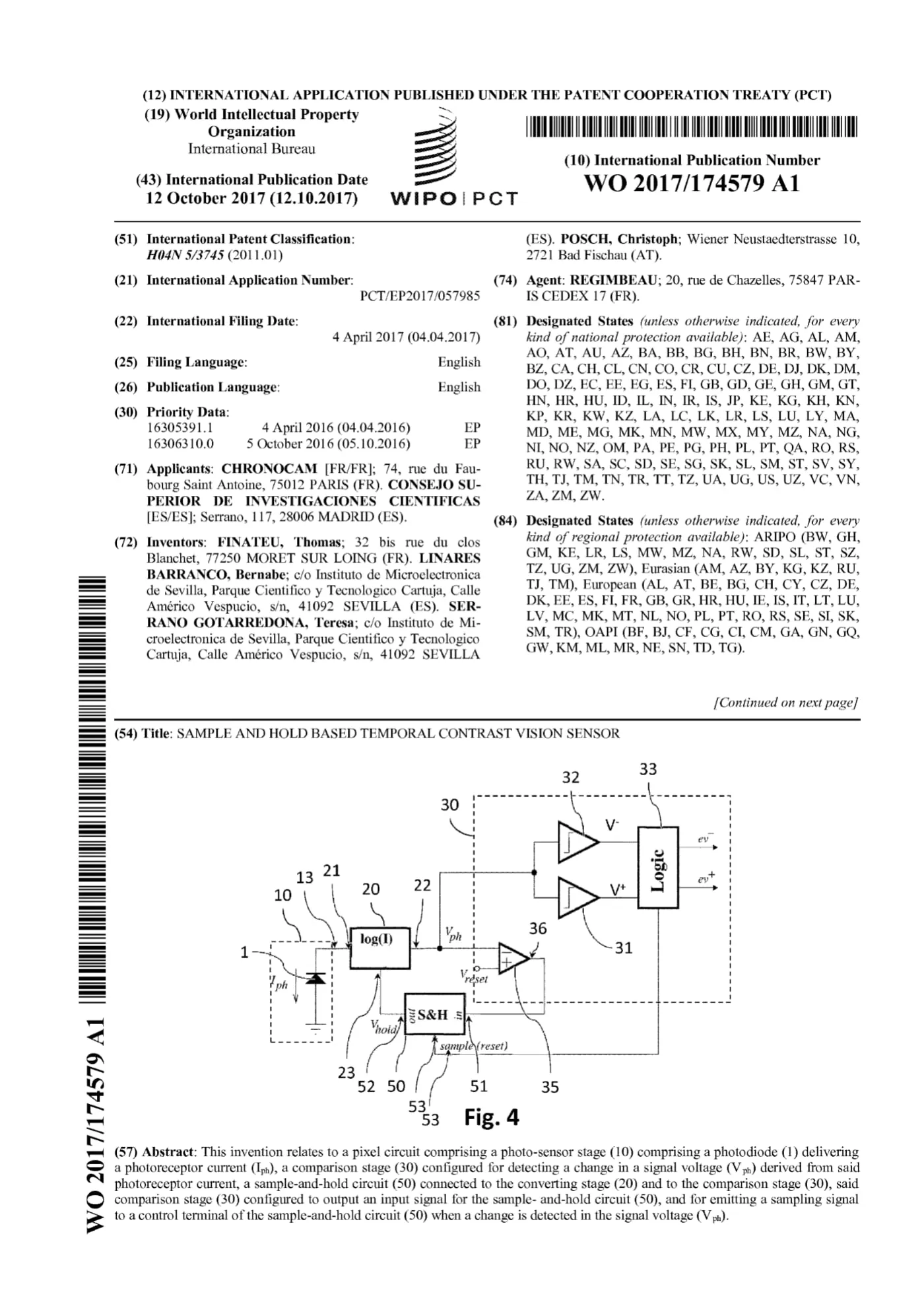
Sample and hold based temporal contrast vision sensor

This invention relates to a pixel circuit comprising a photo-sensor stage comprising a photodiode delivering a photoreceptor current (Iph), a comparison stage (30) configured for detecting a change in a signal voltage (Vph) derived from said photoreceptor current, a sample-and-hold circuit connected to the converting stage and to the comparison stage , said comparison stage configured to output an input signal for the sample- and-hold circuit, and for emitting a sampling signal to a control terminal of the sample-and-hold circuit when a change is detected in the signal voltage (Vph).

Licensed to
Prophesee
Inventors
Finateu, Thomas; Linares-Barranco, Bernabé; Serrano-Gotarredona, Teresa; Posch, Christoph
Holder
Chronocam and Spanish National Research Council
Patent · PDF

LicensedPriority

System and method for prevention against electric discharges and/or electric arcs

The invention relates to a system and method for prevention against electric discharges and/or electric arcs for people located close to an electrical installation . Specifically, the system comprises an actuator device which can shut-off the electrical flow of the electrical installation and which is wirelessly connected to a sensor device that can wirelessly detect electric fields emitted by the body of the person and/or by the electrical installation , and also warn the person that there is a risk of an electric discharge and/or electric arc.

Licensed to
Ilunium System S.L.
Inventors
Charneco Fernández, Juan; Palacios De La Olla, Ricardo; Delgado Restituto, Manuel
Holder
Spanish National Research Council, Juan Charneco Fernández and Ricardo Palacios De La Olla
Group
Wireless Implantable and Wearable Intelligent Biosensor Devices
Patent · PDF

LicensedPriority

Method and device for detecting the temporal variation of the light intensity in a matrix of photosensors

The invention relates to a method and a device for detecting the temporal variation of the light intensity in a matrix of photosensors, comprising a matrix of pixels, a block for the automatic adjustment of the amplification of the photocurrent, and an arbitrating and event-encoding block. Each pixel comprises a photosensor that generates a photocurrent, an adjustable gain current mirror connected to the outlet of the photosensor, a transimpedance amplifier arranged at the outlet of the current mirror, optionally at least one amplification circuit arranged at the outlet of the transimpedance amplifier, and capacitors and detectors of thresholds for determining whether the output voltage exceeds a higher threshold or drops below a lower threshold in order to generate an event in the pixel.

Licensed to
Chronocam
Inventors
Serrano Gotarredona, Teresa; Linares Barranco, Bernabé
Holder
Spanish National Research Council
Patent · PDF

LicensedPriority

Low-mismatch and low-consumption transimpedance gain circuit for temporally differentiating photo-sensing systems in dynamic vision sensors

The invention relates to a low-mismatch and low-consumption transimpedance gain circuit for temporally differentiating photo-sensing systems in dynamic vision sensors, which uses at least one photodiode and at least two in-series transistors, each of the transistors being connected in diode configuration and being positioned at the output of the photodiode. The output current from the photodiode flows through the drain-source channels of the transistors and the source of the last transistor in series is connected to a voltage selected from earth voltage, a constant voltage or a controlled voltage.

Licensed to
Chronocam
Inventors
Serrano Gotarredona, Teresa; Linares Barranco, Bernabé
Holder
Spanish National Research Council
Patent · PDF

Past 20

Patents the institute no longer offers.

PastPriority

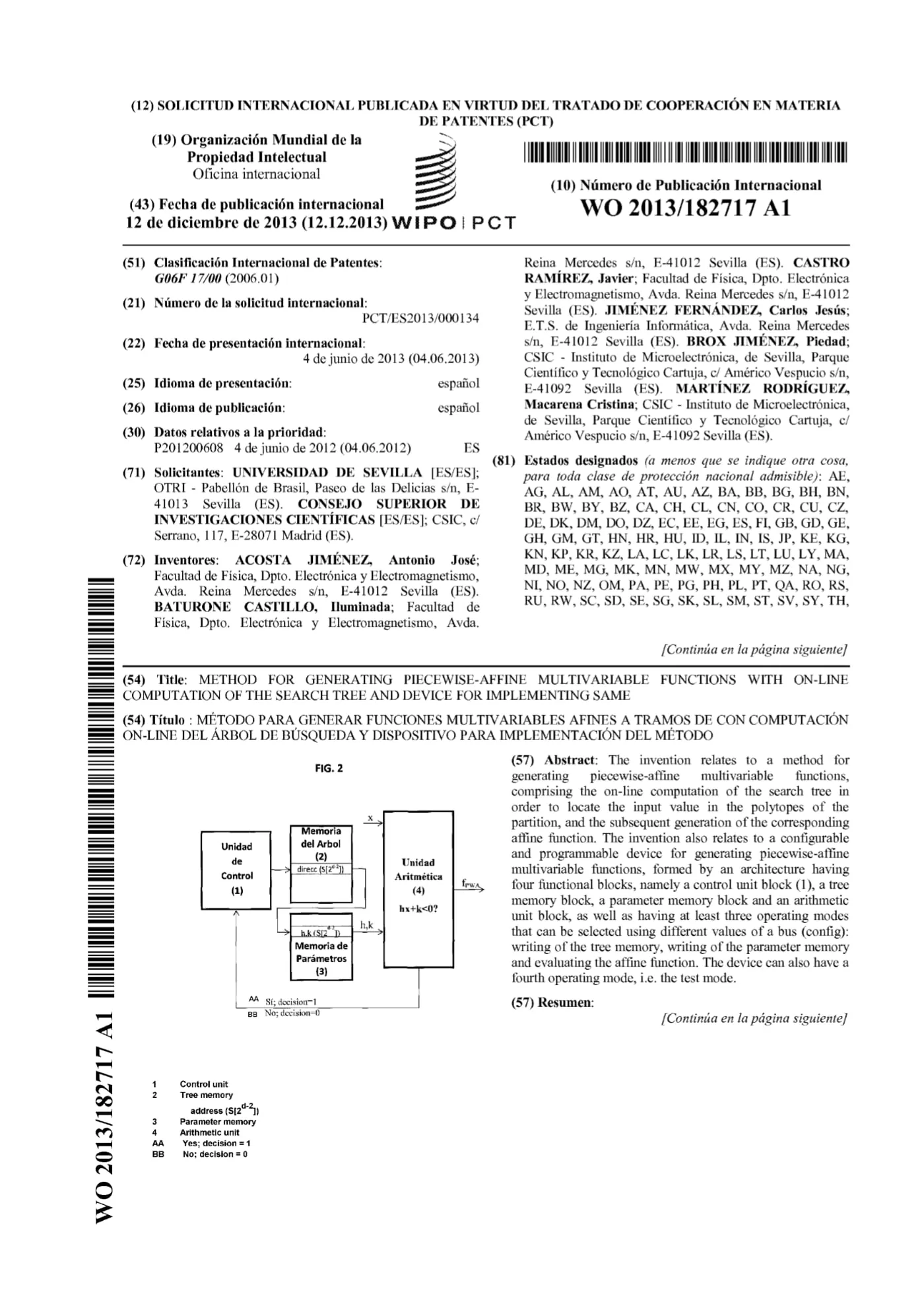
Method for generating piecewise-affine multivariable functions with on-line computation of the search tree and device for implementing same

Method for generating piecewise-affine multivariate functions, wherein the online computation of the search tree is performed in order to locate the input value in the polytopes of the partition, and the subsequent generation of the corresponding affine function. It also proposes a configurable and programmable device for generating piecewise-affine multivariate functions composed of an architecture with four functional blocks namely: a control unit block (1), a tree memory block, a parameter memory block and an arithmetic unit block; and it has at least three operating modes which can be selected using different values of a bus (config): writing of the tree memory, writing of the parameter memory and evaluating the affine function. It may include a fourth operating mode, which is the test mode.

Licensed to
Canaan Research & Investment
Inventors
Acosta Jiménez, Antonio José; Baturone Castillo, Iluminada; Castro Ramírez, Javier; Jiménez Fernández, Carlos Jesús; Brox Jiménez, Piedad; Martínez Rodríguez, Macarena Cristina
Holder
Spanish National Research Council and University of Seville
Patent · PDF

Past

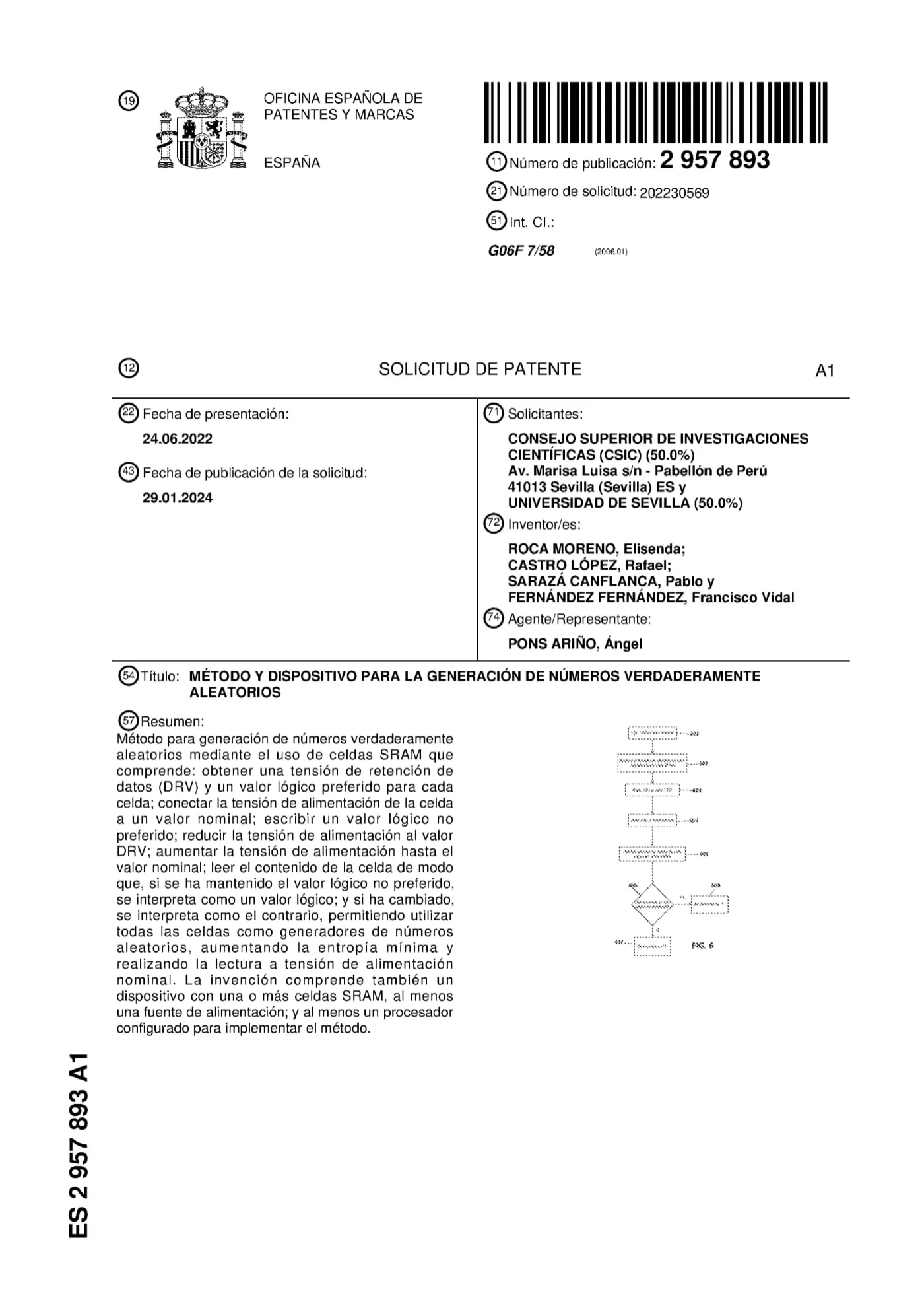
Method and device for generating truly random numbers

CSIC and the University of Seville have developed a method and a device, with which to carry it out, to generate truly random numbers from SRAM cells. The method uses static random access memory (SRAM) cells regardless of their characteristics, whether they are more or less biased towards one of the logical values. In contrast to conventional methods, which only generate truly random numbers using a very limited portion of the total number of cells in an SRAM, this new method relies on the metric of the retained voltage data, which provides the possibility of obtaining randomness from any of these SRAM cells.

Inventors
Roca Moreno, Elisenda; Castro López, Rafael; Sarazá Cantaflaca, Pablo; Fernández Fernández, Francisco Vidal
Holder
University of Seville and Spanish National Research Council
Patent · PDF

Past

Digital pulse OR-combination photomultiplier

The CSIC and the University of Seville have developed a digital pulse OR-combination photomultiplier that reduces the unnecessary energy expenditure that occurs in conventional architectures through the spatial filtering of spurious avalanches. The presented technology, characterised by very compact and energy-efficient macrocells, allows the design of large digital photomultipliers that operate much more efficiently than traditional ones. Companies interested in licensing the patent are sought.

Inventors
Vornicu, Ion; Carmona Galan, Ricardo; Rodriguez Vázquez, Ángel
Holder
University of Seville and Spanish National Research Council
Patent · PDF

Past

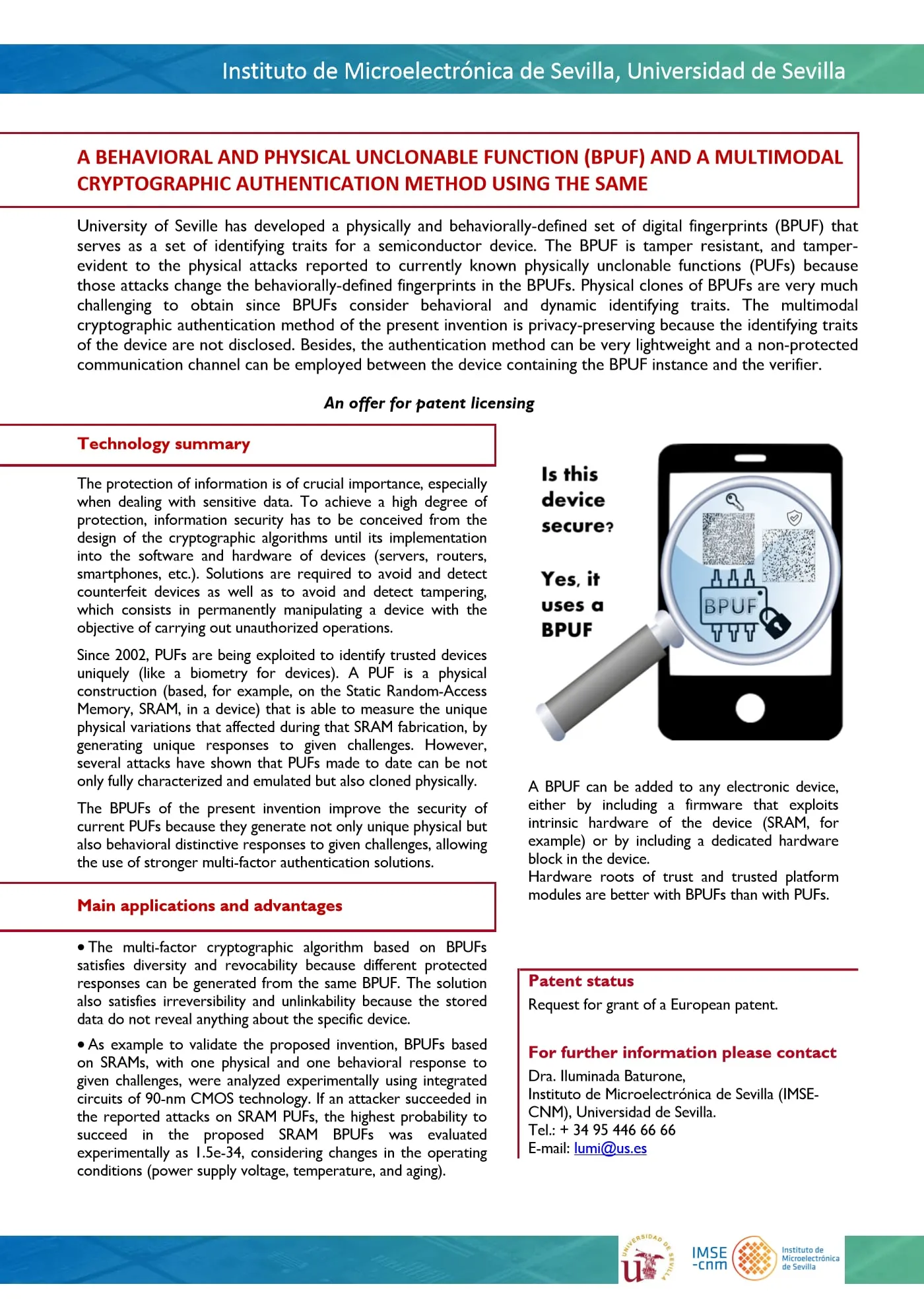
A behavioral and physical unclonable function (BPUF) and a multimodal cryptographic authentication using the same

University of Seville has developed a physically and behaviorally-defined set of digital fingerprints (BPUF) that serves as a set of identifying traits for a semiconductor device. The BPUF is tamper resistant, and tamperevident to the physical attacks reported to currently known physically unclonable functions (PUFs) because those attacks change the behaviorally-defined fingerprints in the BPUFs. Physical clones of BPUFs are very much challenging to obtain since BPUFs consider behavioral and dynamic identifying traits. The multimodal cryptographic authentication method of the present invention is privacy-preserving because the identifying traits of the device are not disclosed. Besides, the authentication method can be very lightweight and a non-protected communication channel can be employed between the device containing the BPUF instance and the verifier.

Inventors
Baturone Castillo, María Iluminada; Prada Delgado, Miguel Ángel
Holder
University of Seville and Spanish National Research Council
Group
Hardware for Cybersecurity
Leaflet · PDF

Past

Fingerprint identification method and device using same

A description is given of a method and a device allowing the generation of a feature vector of a human fingerprint by means of a series of p

rocesses performed on the basis of the image of said fingerprint. These vectors are used to produce a classification, indexing or determination of fingerprint identity and also to protect secrets or to generate cryptographic keys based on fingerprints. The majority of identification methods use feature vectors and techniques for extraction and comparison purposes, which are unsuitable for electronic devices with reduced computing and storage resources. The method proposed in this invention is indeed appropriate, offering good levels of performance in terms of vector extraction times, pairing and ordering times, and memory requirements. The main uses of the invention arise in small automatic fingerprint identification systems that are portable, inexpensive and/or secure, where the user is present and wishes to be identified.

Inventors
Arjona López, María Rosario; Baturone Castillo, María Iluminada
Holder
University of Seville and Spanish National Research Council
Group
Hardware for Cybersecurity
Patent · PDF

Past

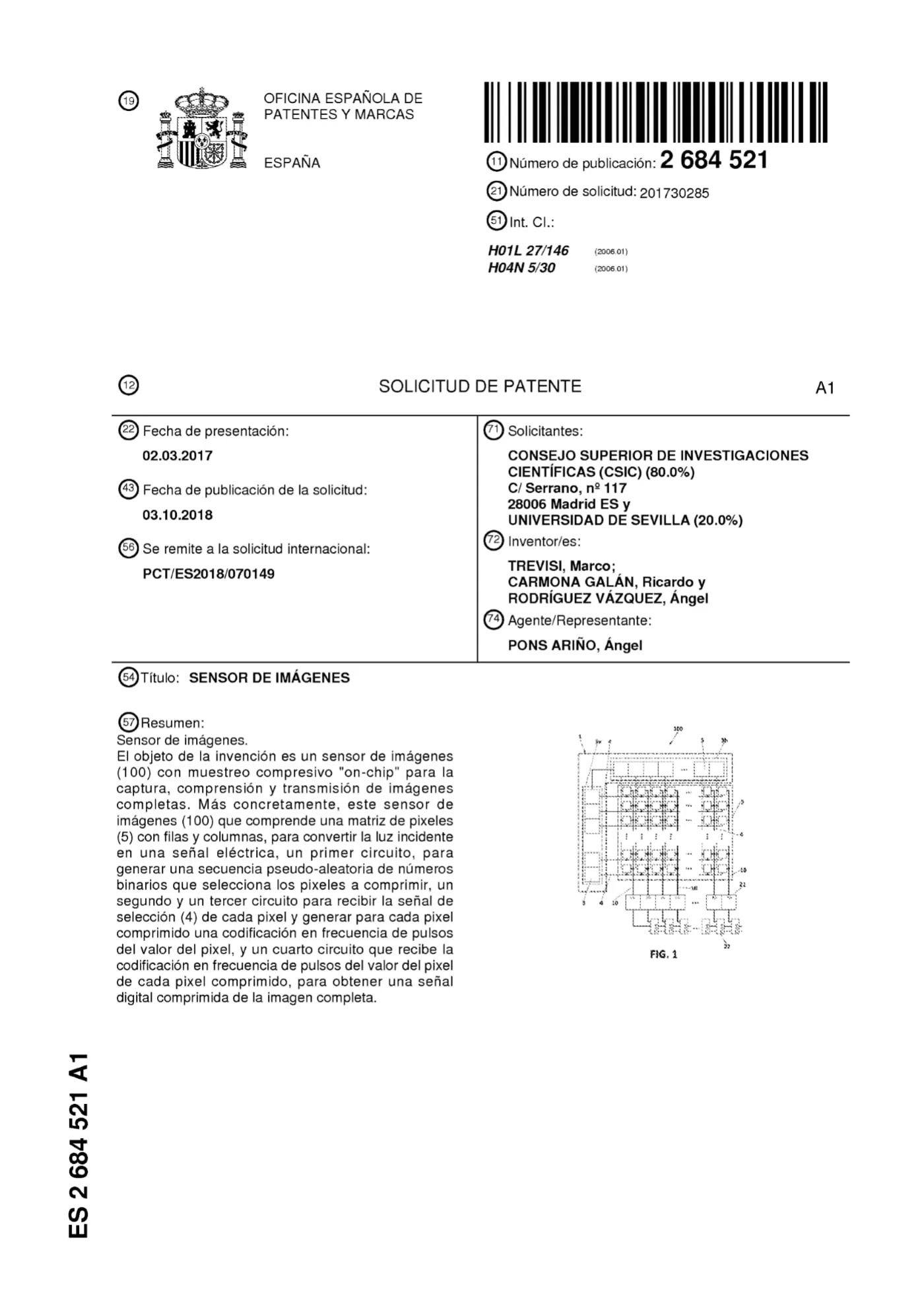
Image Sensor on chip

The invention relates to an image sensor with “on-chip” compressive sensing for capturing, understanding and transmitting entire

images. More specifically, the invention relates to an image sensor comprising: a pixel matrix with rows and columns, for converting incident light into an electrical signal; a first circuit for generating a pseudo-random sequence of binary numbers, which selects the pixels to be compressed; second and third circuits for receiving the selection signal for each pixel and, for each compressed pixel, generating pulse-frequency coding of the value of the pixel; and a fourth circuit which receives the pulse-frequency coding of the value of the pixel for each compressed pixel, in order to obtain a compressed digital signal for the entire image.

Inventors
Treviso, Marco; Carmona Galan, Ricardo; Rodríguez Vázquez, Ángel
Holder
Spanish National Research Council and University of Seville
Patent · PDF

Past

Adaptive method for concurrent digital calibration of the offset in comparators in analog-to-digital converters (ADCs)

The invention relates to an adaptive method for calibrating the offset of comparators in analog-to-digital converters (ADCs). The technique used enables the effective threshold voltage or transition of the comparators to be adjusted by means of a low-cost digital control, without affecting the natural path of the signal, and therefore without interrupting the A/D conversion of the analog input. Said method is therefore a concurrent calibration technique.

Inventors
Ginés Arteaga, Antonio José; Peralías Macías, Eduardo José; Rueda, Adoración
Holder
Spanish National Research Council and University of Seville
Group
ASICs for Harsh Environments
Patent · PDF

Past

Image processor for extracting features

The present invention relates to an image processor for extracting features. The processor comprises a single non-planar chip containing a plurality of integrated sensors and processing resources distributed in two or more layers and configured to capture image frames and extract features of the images. In one particular embodiment, the non-planar chip is a CMOS 3D integrated circuit (CMOS 3D IC) with a vertical distribution of the sensing and processing resources distributed in two or more vertical layers of the integrated circuit. The CMOS 3D IC uses two or more feature detectors in a single chip, reusing a plurality of circuits used to obtain the gradient and key points. The feature detectors include a scale invariant feature transform (SIFT) detector, a Harris detector and a detector based on the Hessian matrix.

Inventors
Suarez Cambre, Manuel; Brea Sánchez, Víctor Manuel; Pardo Seco, Fernando Rafael; Rodríguez Vázquez, Ángel; Carmona Galán, Ricardo
Holder
University of Santiago, University of Seville and Spanish National Research Council

Past

Device for detecting edges and improving the quality of an image

The invention relates to a device for detecting edges and improving the quality of an image, wich includes a group of elemental procesor cells wich are identical and locally interconnected. Each processor cell in turn is characterised by a comparator wich compares , in parallel, each pair of adjacent pixels. The threshold voltage wich establishes the voltage difference between pixels considered to be part of an edge is determined by a time adjustement of a control signal. Said adjustment, combined with that of the filtering control signal, also in time, are the only adjustments required in order to configure the desired processing. No external analog control signals are required. thus making it easier to program the hardware by the device used and reducing the number of digital-to-analog converters in the final system.

Licensed to
Fobos Solutions S.L.
Inventors
Fernández Berni, Jorge; Rodríguez Vázquez, Ángel; Carmona Galan, Ricardo
Holder
University of Seville and Spanish National Research Council
Patent · PDF

Past

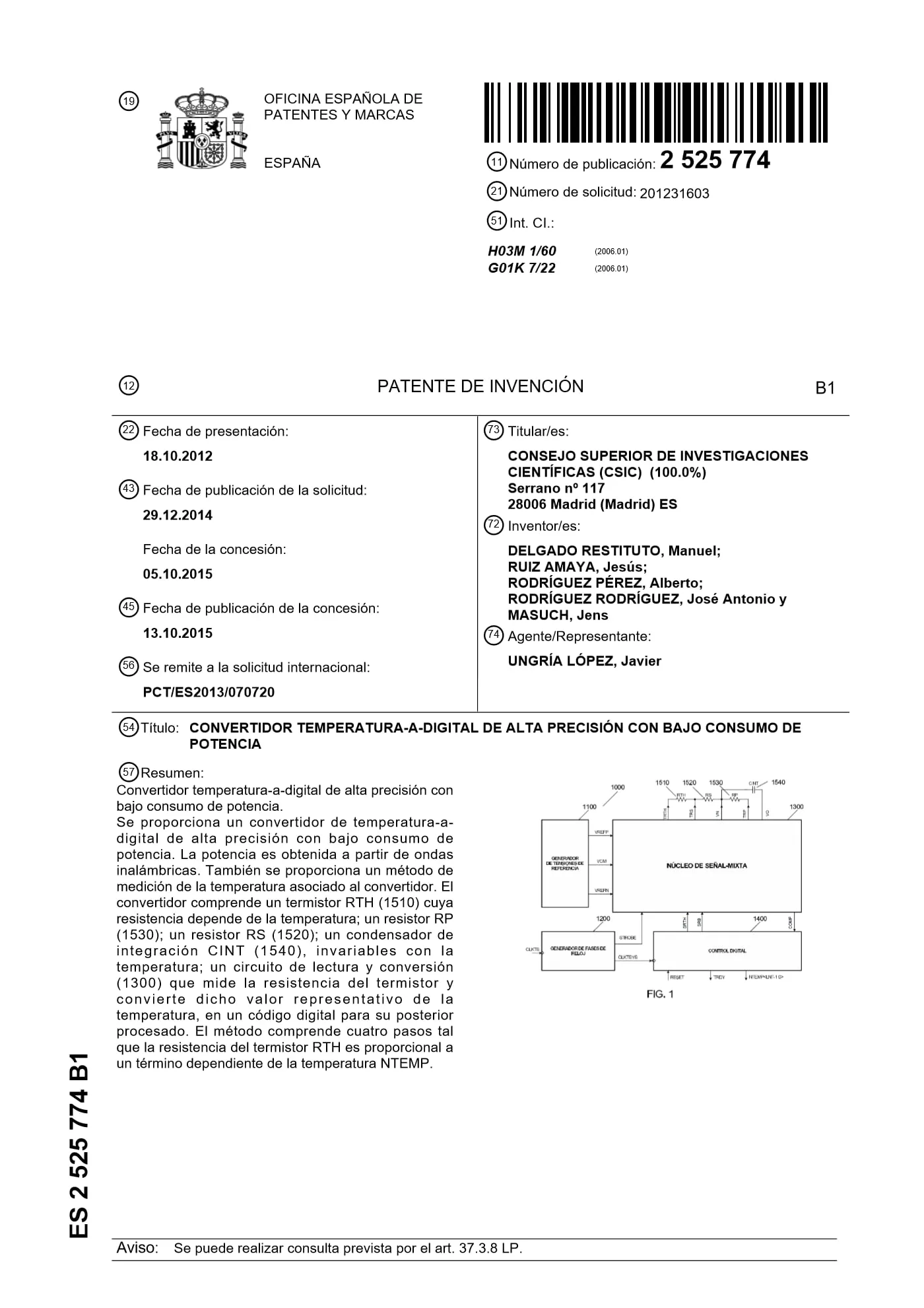
High-precision temperature to digital converter with low power consumption

The invention relates to a high-precision temperature-to-digital converter with low power consumption. The power is obtained from wireless waves. The invention also relates to a method for measuring the temperature associated with the converter. The converter comprises a thermistor RTH (1510), the resistance of which depends on the temperature; a resistor RP (1530), a resistor RS (1520), and an integration capacitor CINT (1540) which are temperature invariable; and a reading and conversion circuit (1300) that measures the resistance of the thermistor and converts said value representative of the temperature into a digital code for subsequent processing. The method comprises fours steps such that the resistance of the RTH thermistor is proportional to an expression dependent on the temperature NTEMP.

Inventors
Delgado Restituto, Manuel; Ruiz Amaya, Jesús; Rodríguez Pérez, Alberto; Rodríguez Rodríguez, José Antonio; Masuch, Jens
Holder
Spanish National Research Council
Group
Wireless Implantable and Wearable Intelligent Biosensor Devices
Patent · PDF

Past

Device for the hardware detection of local extremes in an image

The invention relates to a device and method for the hardware detection of local extremes in an image, comprising a plurality of mixed-signal processing elementary cells that are locally interconnected and comprising, in each cell, a first switch configured to allow the pre-charging of a capacitor at the supply voltage. According to the invention, once the capacitor has been pre-charged it is discharged via a second switch connected to a current source that varies in an increasing monotone manner with the analog voltage that represents the value of the pixel in question. The value of the pixel is compared asynchronously with the neighbouring pixels of the neighbouring cells using two inverters, a digital NO gate, a digital NAND gate, third and fourth switches and a memory element for storing the result.

Licensed to
Fobos Solutions S.L.
Inventors
Fernández Berni, Jorge; Rodríguez Vázquez, Ángel; Carmona Galan, Ricardo
Holder
University of Seville and Spanish National Research Council
Patent · PDF

Past

System and method for the calibration of steps of acquisition and conditioning of electrical biopotentials

The invention relates to a system and a method for 35000 the calibration of steps of acquisition and conditioning of electrical biopotentials. Said system comprises means for the definition of the spectral band for capture according to the type of biopotential to be 35100 35200 monitored and means for adjusting the voltage gain levéis prior to the digitalisation of said biopotential. The invention also relates to Monitorización Ajuste PGC por biopotencial usuario the method associated with the definition of the spectral band for capture according to the type of biopotential to be monitored and the adjustment of the voltage gain levéis prior to the digitalisation of said biopotential.

Inventors
Delgado-Restituto, Manuel; Rodríguez-Pérez, Alberto; Ruiz Amaya, Jesus
Holder
Spanish National Research Council
Group
Wireless Implantable and Wearable Intelligent Biosensor Devices
Patent · PDF

Past

System and method for acquiring and transferring neuronal activity

Neural activity acquisition and transfer system comprising at least a plurality of bioelectric sensors, a wireless transceiver, a communications node connected between the plurality of bioelectric sensors and the wireless transceiver, and a plurality of intracranial electrodes, such that the The communications node is configured to transmit data bi-directionally between the plurality of bioelectric sensors and the wireless transceiver, so that in the direction of data transmission from the wireless transceiver to the bioelectric sensors, the communications node manages a configuration of parameters, a calibration and a mode of operation of the bioelectric sensors and, in the sense of data transmission from the bioelectric sensors to the wireless transceiver, collects, sets, and shapes neuronal information from a neuronal signal captured by the plurality of bioelectric sensors.

Inventors
Delgado-Restituto, Manuel; Rodríguez-Pérez, Alberto; Rodríguez-Vázquez, Ángel
Holder
Spanish National Research Council and University of Seville
Group
Wireless Implantable and Wearable Intelligent Biosensor DevicesIntegrated Interface Circuits and Sensory Systems
Patent · PDF

Past

Neural sensing channel and neural sensing method

The present invention relates to a sensing channel for acquiring, digitizing, and processing neural signáis o captured by means of an intracranial electrode and to the related methods. The provided channel comprises means v and mechanisms for data compression in real time which include differentiation and compression by setting the parameters of a neural signal to obtain a simplified representation of the action potentials detected, Le., a compressed neural signal. The invention is useful in physical technology and other sectors, and particularly the information and communications technology area with uses in bioengineering.

Inventors
Delgado-Restituto, Manuel; Rodríguez Pérez, Alberto; Rodríguez-Vazquez, Ángel
Holder
Spanish National Research Council and University of Seville
Group
Wireless Implantable and Wearable Intelligent Biosensor DevicesIntegrated Interface Circuits and Sensory Systems
Patent · PDF

Past

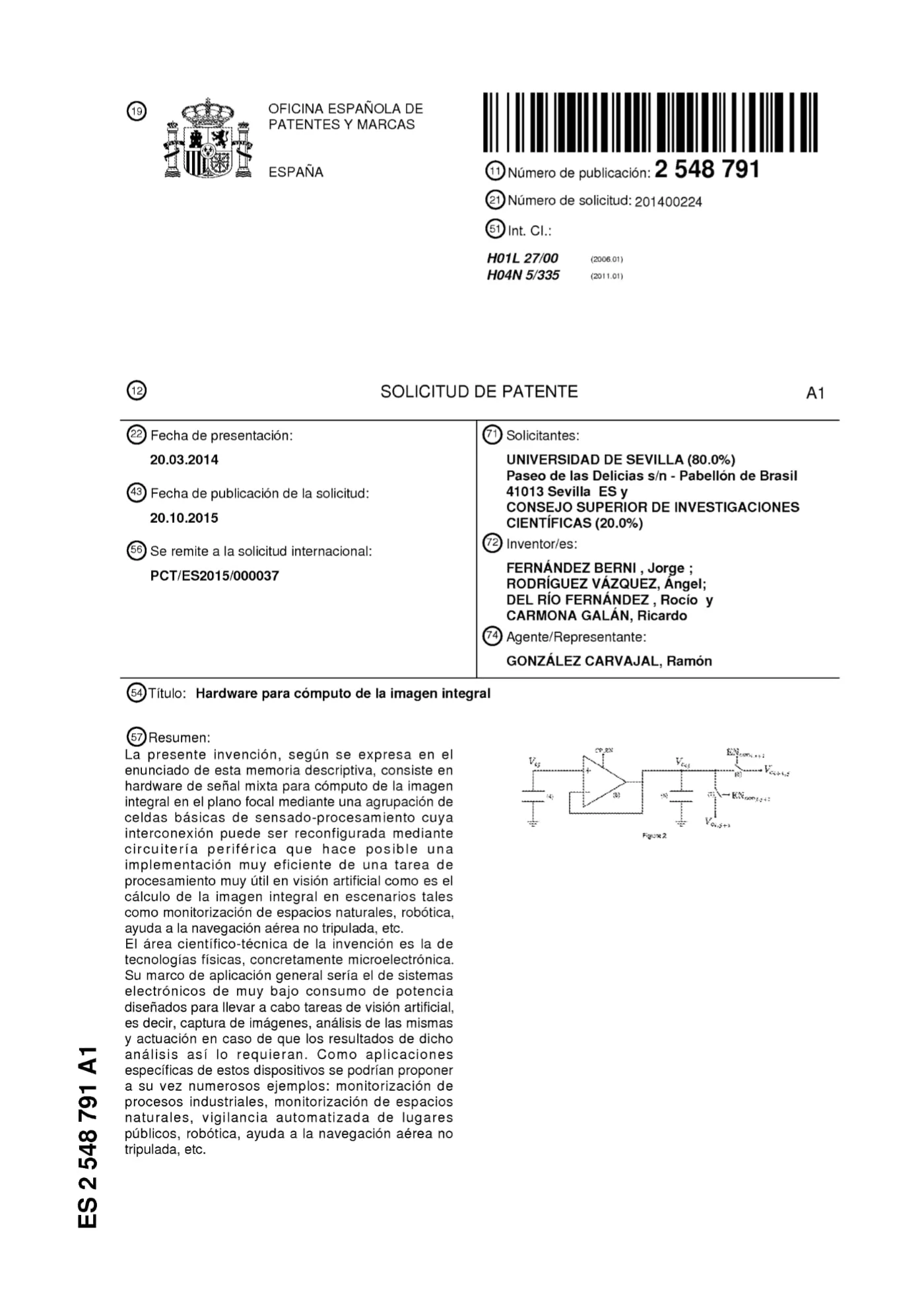
Hardware for computing the integral image

The invention relates to mixed-signal hardware for computing the integral image in the focal plane using a cluster of basic sensor-processing cells, the interconnection of which cluster can be reconfigured using peripheral circuitry that permits a processing task, that is very useful in artificial vision, to be very efficiently carried out, such as the calculation of the integral image in settings, such as, inter alia, monitoring natural spaces, robotics, and aiding unmanned air navigation. The scientific-technical field of the invention is that of physical technologies, in particular microelectronics. The general application framework of the invention is that of very low power consumption electronic systems designed to carry out artificial vision tasks, namely capturing images, analysing same, and acting if required by the results of said analysis.

Inventors
Fernández-Berni, Jorge; Rodríguez-Vázquez, Ángel; Del Río-Fernández, Rocio; Carmona-Galán, Ricardo
Holder
University of Seville and Spanish National Research Council
Patent · PDF

Past

Method and device for generating truly random numbers and identifiers

The invention relates to a method comprising two steps. The first step involves classifying the static memory cells into two discrete sets according to their behaviour towards repeatedly being connected to a power supply after having been with out a power supply for a sufficient period of time, such that the cells of one of the sets are suitable for generating identifiers (key or secret) and the cells of the other set are suitable for generating truly random numbers. Thanks to this classification, in the second step, involving the generation of numbers, the identifiers and the random numbers generated perform better. The invention also relates to a device for carrying out the method according to the invention, said method being carried out by adding very simple circuitry to the memory or running very simple software. The scientific-technical fields of the invention are those of cryptography, electronic technology, security and privacy.

Inventors
Baturone Castillo, María Iluminada; Eiroa Lorenzo, Susana; Prada Delgado, Miguel Ángel
Holder
University of Seville and Spanish National Research Council
Group
Hardware for Cybersecurity
Patent · PDF

Past

Highly Energy Efficient Widely Programmable Transconductor

The University of Seville, in collaboration with CSIC, has developed a novel transconductor, which is widely tunable and reconfigurable to a number of circuit specifications with an adaptive power consumption. Current-starving techniques are combined with programmable output stages so that the output current range and granularity can be arbitrarily set, while increasing energy efficiency with the number of active stages. These characteristics make the proposed circuit very suited to enlarge the autonomy and battery life in a number of portable multi-mode electronic devices, including – among others – the following applications:

Wireless acommunication systems, including next-generation 4G/5G mobile telecom terminals

Software-defined-radio devices

Instrumentation

Wireless smart sensors

Biomedical devices

Ultra-low-voltage devices.

Inventors
Morgado García de Polavieja, Alonso; del Río Fernández, Rocío; de la Rosa Utrera, José Manuel
Holder
University of Seville and Spanish National Research Council

Past

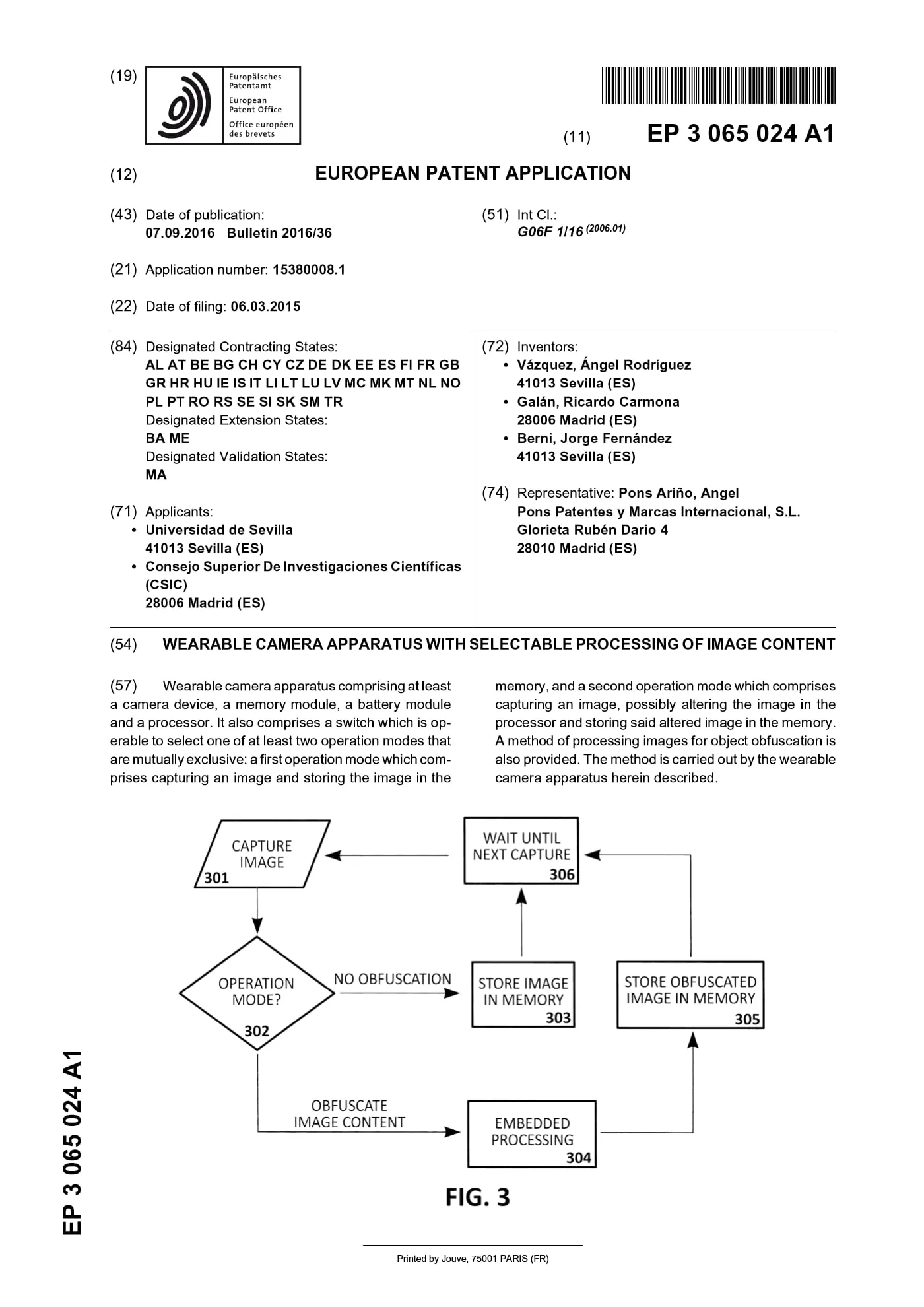
Wearable camera apparatus with selectable processing of image content

Wearable camera apparatus comprising at least a camera device, a memory module, a battery module and a processor. It also comprises a switch which is operable to select one of at least two operation modes that are mutually exclusive: a first operation mode which comprises capturing an image and storing the image in the memory, and a second operation mode which comprises capturing an image, possibly altering the image in the processor and storing said altered image in the memory. A method of processing images for object obfuscation is also provided. The method is carried out by the wearable camera apparatus herein described.

Inventors
Rodríguez Vázquez, Ángel; Carmona Galán, Ricardo; Fernández Berni, Jorge
Holder
Spanish National Research Council and University of Seville
Patent · PDF

Past

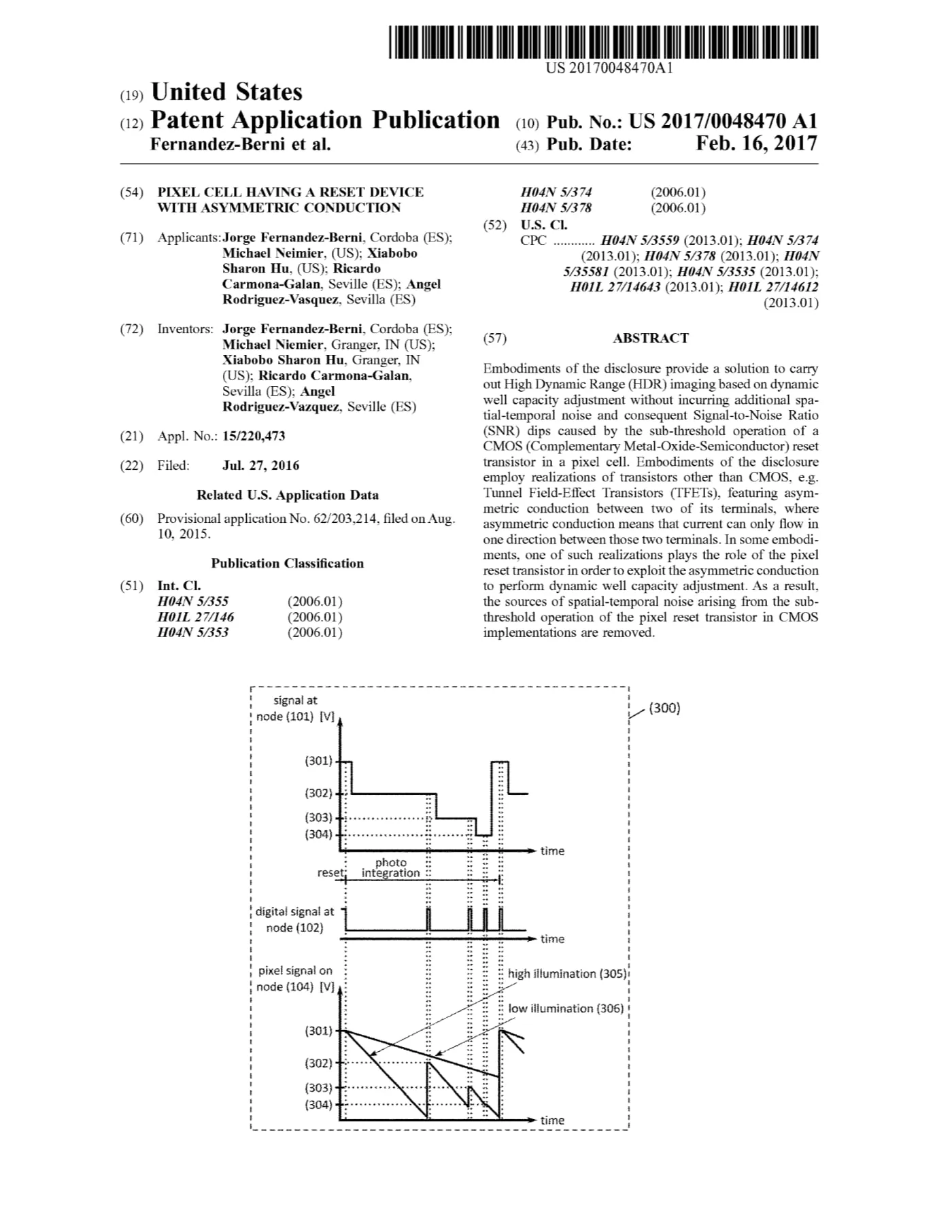
Pixel cell having a reset device with asymmetric conduction

Embodiments of the disclosure provide a solution to carry out High Dynamic Range (HDR) imaging based on dynamic well capacity adjustment without incurring additional spatial-temporal noise and consequent Signal-to-Noise Ratio (SNR) dips caused by the sub-threshold operation of a CMOS (Complementary Metal-Oxide-Semiconductor) reset transistor in a pixel cell. Embodiments of the disclosure employ realizations of transistors other than CMOS, e.g. Tunnel Field-Effect Transistors (TFETs), featuring asymmetric conduction between two of its terminals, where asymmetric conduction means that current can only flow in one direction between those two terminals. In some embodiments, one of such realizations plays the role of the pixel reset transistor in order to exploit the asymmetric conduction to perform dynamic well capacity adjustment. As a result, the sources of spatial-temporal noise arising from the sub-threshold operation of the pixel reset transistor in CMOS implementations are removed.

Inventors
Fernández-Berni, Jorge; Niemier, Michael; Hu, Xiaobo Sharon; Carmona-Galán, Ricardo; Rodríguez-Vázquez, Ángel
Holder
Spanish National Research Council
Patent · PDF

Past

Circuit for recognizing and establishing categories of binary patterns

Circuit for recognizing and establishing categories of binary patterns. The object of the invention is a circuit for the recognition and establishment of categories of binary patterns, capable of grouping by similarity a collection of binary patterns presented sequentially and/or iteratively at the circuit inputs. The circuit of the invention has the advantage of greater speed compared with software algorithms that perform similar functions and is less complex than other hardware-based solutions. The circuit is useful in speech recognition devices, as well as in robotics and process automation.

Inventors
Linares Barranco, Bernabé; Serrano Gotarredona, Teresa
Holder
Spanish National Research Council