


Through a laser maze and cryptographic challenges, researchers from the center brought key concepts of digital protection closer to hundreds of students from all over Europe
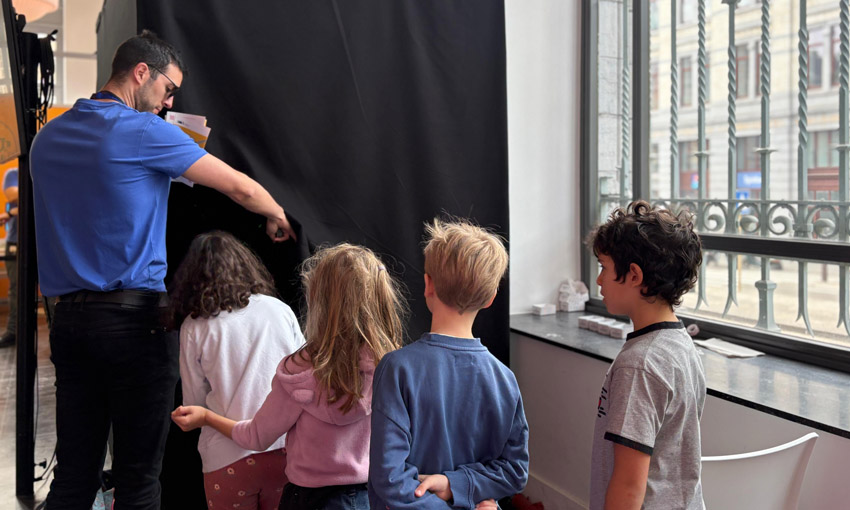
For the third consecutive year, the Institute of Microelectronics of Seville (IMSE) participated in the European Commission's Science Fair, held in Brussels from March 18th to 20th. This year, the Institute received special recognition as the only center of the Consejo Superior de Investigaciones Científicas (CSIC) selected to represent the institution at this international event.
This year's Fair featured 41 selected projects from across Europe, including SQPRIM, an initiative developed by IMSE. This project aims to explore new methods for strengthening security in digital environments, an area of ??increasing importance in the information age.
To bring cybersecurity closer to the public, IMSE had its own stand entitled "Mission Impossible: The Secrets of the Digital World," where researchers from the Hardware Security Group gave demonstrations of robust encryption systems and cryptographic keys, enabling them to decrypt messages like true secret agents.
The main attraction of the stand was a laser maze, which visitors had to navigate. As they dodged the laser beams, they obtained clues and information to complete the following activities. Each beam of light represented a barrier that, just like in real digital systems, had to be overcome with precision and strategy.
During the three days of the Fair, hundreds of students from all over Europe visited the stand, showing great interest in understanding how security works in the digital world and learning techniques to protect their information online. In addition to the practical demonstrations, the IMSE researchers maintained close contact with the public, answering questions and inspiring scientific vocations among the younger attendees.
Meanwhile, our colleague Piedad Brox wanted to introduce mathematics to younger children. To do this, she visited the San Francisco de Paula International School, where 3rd and 5th grade students learned how mathematics helps us care for our planet, prevent climate change, and protect the ecosystems and animals that inhabit them.
Once again, the presence of the Institute of Microelectronics of Seville at this event reinforces the Center's commitment to scientific dissemination and the transfer of knowledge to society.
Instituto de Microelectrónica de Sevilla
March 26, 2026